


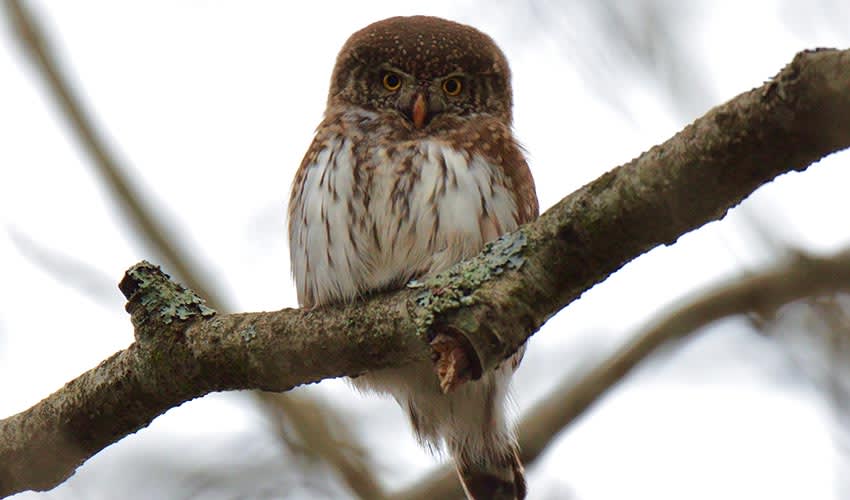
This diminutive raptor may look harmless, but it embodies the power, precision, and adaptability of nature’s top predators. Found across northern and central Europe, Siberia, and parts of Asia, the Eurasian pygmy owl thrives in coniferous and mixed forests, particularly in cold, mountainous, or boreal regions where spruce and pine trees dominate. Its compact body, rounded head, and short tail make it perfectly suited for darting through dense woodland canopies, while its beautifully mottled brown or reddish plumage, speckled with white spots, provides ideal camouflage against tree bark.
What truly sets this owl apart is its behavior. Unlike most owls that come alive at night, the Eurasian pygmy owl is diurnal, meaning it hunts during the day—usually at dawn and dusk. Its bright yellow eyes and exceptional vision help it spot prey even in dim light. Despite its small size, it is a fearless and efficient hunter, preying on small mammals like voles and mice, as well as birds such as sparrows, finches, and tits—sometimes even ones as large as itself. It hunts from a perch, sitting silently and scanning its surroundings before swooping down with astonishing speed and accuracy. When food is plentiful, it has a habit of storing its kills by wedging them into tree bark or impaling them on thorns—a clever way to build a winter food reserve when prey becomes scarce.
The Eurasian pygmy owl’s nesting habits are equally fascinating. It doesn’t build its own nest but instead takes over abandoned woodpecker holes in old trees, which provide perfect shelter and insulation for raising chicks. Once the chicks hatch, both parents feed them a steady supply of small rodents and birds. After about a month, the young owlets fledge but remain dependent on their parents for several more weeks as they learn to hunt.
Distribution
 Austria
 Belarus
 Belgium
 Bosnia And Herz.
 Bulgaria
 China
China Croatia
 Czechia
 Denmark
 Estonia
 Finland
 France
 Germany
 Greece
 Italy
Italy Kazakhstan
 Latvia
 Liechtenstein
 Lithuania
 Mongolia
 Montenegro
 Norway
 Poland
 Romania
 Russia
 Serbia
 Slovakia
 Slovenia
 Spain
Spain Sweden
 Switzerland
 Ukraine
Anything we've missed?
Help us improve this page by suggesting edits. Glory never dies!
Suggest an editGet to know me
Terrestrial / Aquatic
Altricial / Precocial
Polygamous / Monogamous
Dimorphic (size) / Monomorphic
Active: Diurnal / Nocturnal
Social behavior: Solitary / Pack / Herd
Diet: Carnivore / Herbivore / Omnivore / Piscivorous / Insectivore
Migratory: Yes / No
Domesticated: Yes / No
Dangerous: Yes / No




