


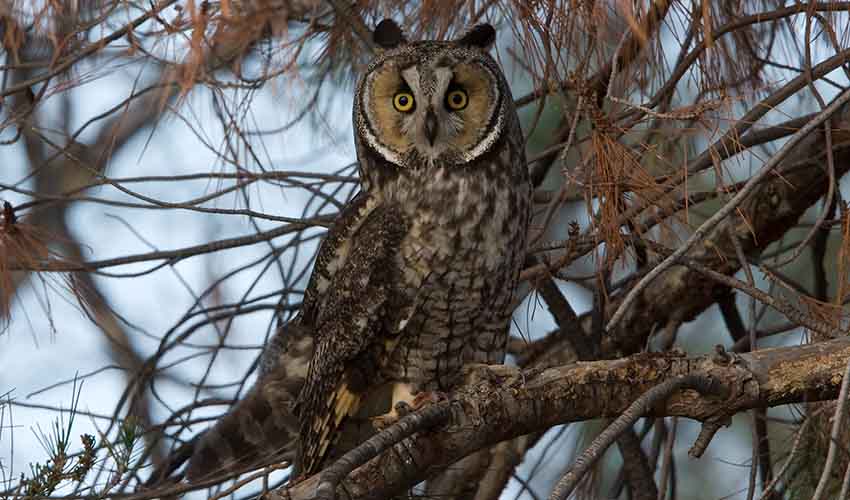
Found across Europe, Asia, North America, and parts of North Africa, this adaptable owl thrives in woodlands, farmlands, and open meadows, where trees meet open ground. With its haunting yellow eyes, slender build, and ghostlike flight, the long-eared owl is a quiet presence in the night, perfectly evolved for stealth, precision, and survival in diverse habitats.
At first glance, the long-eared owl’s beauty is strikingly subtle. It has a slender body covered in intricate mottled plumage—a mix of brown, black, buff, and gray that mimics tree bark perfectly. When it perches upright against a branch, it nearly vanishes, a living shadow among leaves and twigs. Its most distinctive features are the elongated ear tufts, which stand tall above its head and give it a look of perpetual alertness. Despite their name, these tufts are not ears at all but movable feathers used for communication and camouflage. When threatened or curious, the owl raises them high; when relaxed, they lie flat. Its true ears are hidden asymmetrically on either side of its skull, giving it superb directional hearing—able to detect the faintest rustle of a mouse beneath leaves or snow.
In flight, the long-eared owl is the embodiment of silent grace. Its wings are long and rounded, allowing for low, buoyant glides as it hunts over fields and grasslands at dusk. Its feathers are uniquely structured to dampen noise: tiny serrations along the edges break up airflow, enabling it to move without a sound. This makes it one of the most efficient and stealthy predators of the night. Its diet consists mostly of small mammals, especially voles, mice, and shrews, though it occasionally takes small birds and insects. After digesting its prey, the owl coughs up pellets—compact bundles of fur and bones—that provide scientists with valuable clues about its diet and habitat.
Distribution
 Afghanistan
 Albania
 Algeria
 Argentina
 Armenia
 Austria
 Azerbaijan
 Bahrain
 Bangladesh
 Belarus
 Belgium
 Belize
 Bermuda
 Bhutan
 Bolivia
 Bosnia And Herz.
 Brazil
 British Virgin Is.
 Brunei
 Bulgaria
 Cameroon
 Canada
 Cape Verde
 Cayman Islands
 Chad
Chad Chile
Chile China
China Colombia
 Costa Rica
 Croatia
 Cuba
Cuba Cyprus
 Czechia
 Denmark
 Dominican Republic
 Ecuador
 Egypt
Egypt Eritrea
 Estonia
 Ethiopia
 Falkland Islands
 Faroe Islands
 Finland
 France
 French Guiana
 Georgia
 Germany
 Gibraltar
 Greece
 Greenland
 Guam
Guam Guatemala
 Guinea
 Guyana
 Haiti
Haiti Hong Kong
 Hungary
 Iceland
 India
India Iran
Iran Iraq
Iraq Ireland
 Israel
 Italy
Italy Japan
Japan Jordan
 Kazakhstan
 Kenya
Kenya Korea
Korea Kuwait
 Kyrgyzstan
 Laos
Laos Latvia
 Lebanon
 Liberia
 Libya
Libya Liechtenstein
 Lithuania
 Luxembourg
 Malaysia
 Maldives
 Mali
Mali Malta
Malta Marshall Islands
 Mauritania
 Mexico
 Micronesia
 Moldova
 Mongolia
 Montenegro
 Morocco
 Myanmar
 Nepal
Nepal Netherlands
 Niger
Niger Nort. Mariana Is.
 North Korea
 North Macedonia
 Norway
 Oman
Oman Pakistan
 Paraguay
 Peru
Peru Philippines
 Poland
 Portugal
 Puerto Rico
 Qatar
Qatar Romania
 Russia
 Saint Pierre
 Saudi Arabia
 Senegal
 Serbia
 Singapore
 Slovakia
 Slovenia
 South Georgia
 Spain
Spain Sri Lanka
 Sudan
Sudan Suriname
Svalbard
Suriname
Svalbard Sweden
 Switzerland
 Syria
Syria Taiwan
 Tajikistan
 Thailand
 Trinidad & Tobago
 Tunisia
 Turkmenistan
 Turkey
 UAE
UAE US Minor Is.
 US Virgin Islands
 Uganda
 Ukraine
 United Kingdom
 United States
 Uruguay
 Uzbekistan
 Venezuela
 Vietnam
 Yemen
YemenAnything we've missed?
Help us improve this page by suggesting edits. Glory never dies!
Suggest an editGet to know me
Terrestrial / Aquatic
Altricial / Precocial
Polygamous / Monogamous
Dimorphic (size) / Monomorphic
Active: Diurnal / Nocturnal
Social behavior: Solitary / Pack / Herd
Diet: Carnivore / Herbivore / Omnivore / Piscivorous / Insectivore
Migratory: Yes / No
Domesticated: Yes / No
Dangerous: Yes / No




