


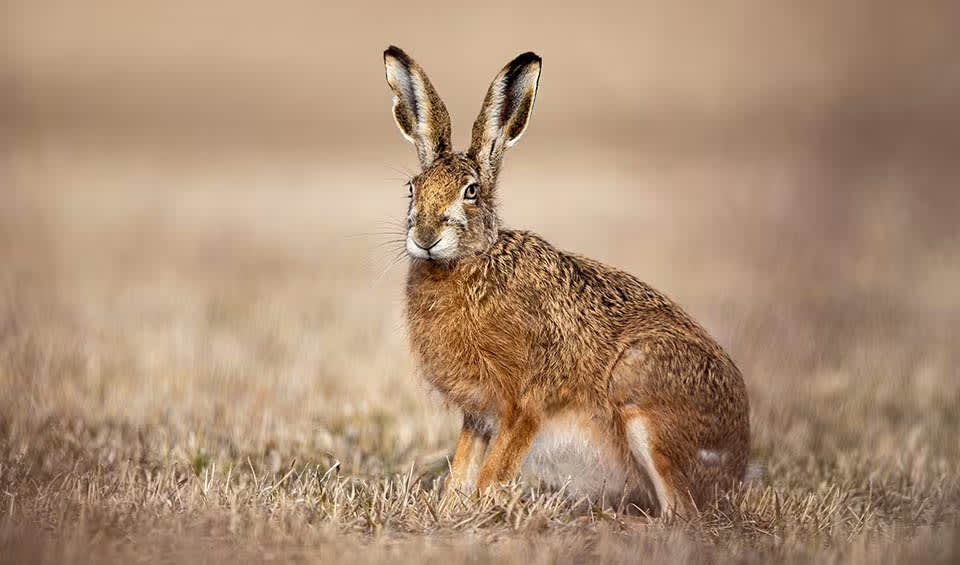
This species has been introduced to other parts of the world, such as North America and Australia, often for sport hunting. The European hare is a vital part of the ecosystem, known for its unique behaviors and physical adaptations that enable it to thrive in a variety of environments, from farmlands to open fields.
European hares have long, powerful legs that allow them to reach speeds of up to 70 km/h (about 43 mph) when evading predators. This makes them one of the fastest terrestrial animals and a difficult target for predators such as foxes and large birds of prey. The European hare’s body is adapted for high-speed chases with a larger heart and nostrils compared to similar-sized animals, allowing for better oxygen intake during a sprint.
Another notable feature is the European hare’s long ears, which can be over 10 cm (4 in) in length. These are not just for hearing; they also help in thermoregulation, releasing heat to help cool the hare’s body during hot weather. The color of its fur is typically brownish with a greyish-white belly, providing camouflage in its natural habitat. During winter, their fur can become more greyish, blending into the frosted landscapes.
European hares are known for their solitary and nocturnal behavior, although they are sometimes active during the day. They do not dig burrows like rabbits but instead rest in a small depression in the ground called a “form,” which offers some protection from the elements and predators. European hares are also famous for their behavior during the breeding season, which includes a phenomenon known as “boxing.” This activity, where hares stand on their hind legs and “box” at each other, is usually between a female and a male, often as the female tests the male’s fitness as a mate or wards off unwelcome advances.
Distribution
 Albania
 Argentina
 Australia
 Austria
 Barbados
 Belarus
 Belgium
 Bolivia
 Bosnia And Herz.
 Brazil
 Bulgaria
 Canada
 Chile
Chile Croatia
 Czechia
 Denmark
 Estonia
 Falkland Islands
 Finland
 France
 Germany
 Greece
 Grenada
Guadeloupe
Grenada
Guadeloupe Hungary
 Iran
Iran Iraq
Iraq Ireland
 Israel
 Italy
Italy Kazakhstan
 Latvia
 Liechtenstein
 Lithuania
 Luxembourg
 Moldova
 Montenegro
 Netherlands
 New Zealand
 North Macedonia
 Paraguay
 Poland
 Romania
 Russia
Réunion
Russia
Réunion Serbia
 Slovakia
 Slovenia
 Spain
Spain Sweden
 Switzerland
 Syria
Syria Turkey
 Ukraine
 United Kingdom
 United States
 Uruguay
Anything we've missed?
Help us improve this page by suggesting edits. Glory never dies!
Suggest an editGet to know me
Terrestrial / Aquatic
Altricial / Precocial
Polygamous / Monogamous
Dimorphic (size) / Monomorphic
Active: Diurnal / Nocturnal
Social behavior: Solitary / Pack / Herd
Diet: Carnivore / Herbivore / Omnivore / Piscivorous / Insectivore
Migratory: Yes / No
Domesticated: Yes / No
Dangerous: Yes / No




