


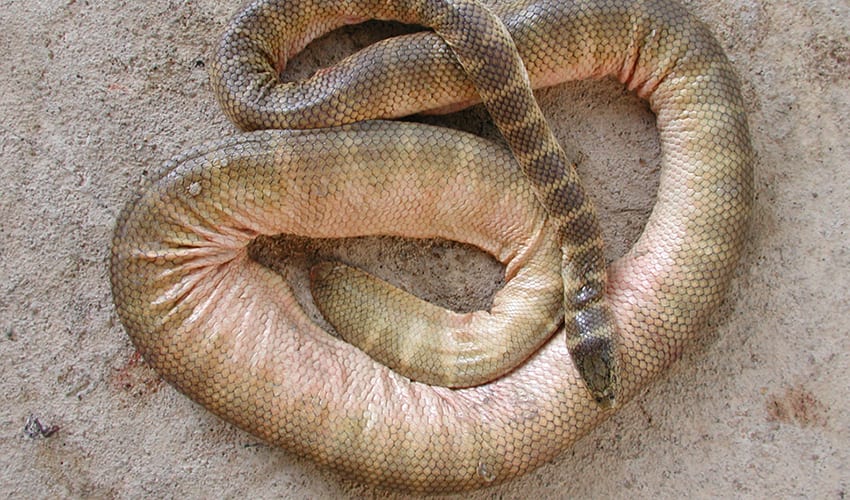
One of the ocean’s most graceful yet formidable reptiles—a slender, silver-and-gold swimmer that glides effortlessly through tropical waters. Found in the warm seas of Southeast Asia, northern Australia, and parts of the Indian Ocean, this snake is famous not only for its beauty but also for its reputation: it is often said to have one of the most potent venoms of any snake in the world. Despite this, it’s remarkably calm and rarely poses a threat to humans, preferring a life of quiet drifting among coral reefs and sandy seafloors.
The faint-banded sea snake is medium-sized and has a slender, cylindrical body and a flattened, paddle-shaped tail perfectly adapted for swimming. Its coloration is striking yet subtle—silvery or pale yellow with faint gray or olive bands running across the body, which give it its name. The scales are smooth and glossy, reflecting light underwater, which helps it blend into the shimmering surface of the ocean. Its head is small and narrow, and its nostrils are positioned on top of the snout, allowing it to breathe easily at the surface.
This sea snake spends nearly all of its life in the water, coming up only briefly for air. It’s an expert diver, able to stay submerged for up to eight hours thanks to its ability to absorb some oxygen through its skin. It inhabits shallow coral reefs, lagoons, and coastal areas, where it hunts for small fish and eels, using quick, precise strikes to inject venom. Its venom, while extremely potent, is delivered in very small quantities, and the snake is non-aggressive, often described by divers as shy and gentle. Encounters with humans are rare, and bites almost never occur unless the animal is provoked or handled carelessly.
Distribution
 Cambodia
 Indonesia
 Malaysia
 Papua New Guinea
 Philippines
 Singapore
 Thailand
 Vietnam
Anything we've missed?
Help us improve this page by suggesting edits. Glory never dies!
Suggest an editGet to know me
Terrestrial / Aquatic
Altricial / Precocial
Polygamous / Monogamous
Dimorphic (size) / Monomorphic
Active: Diurnal / Nocturnal
Social behavior: Solitary / Pack / Herd
Diet: Carnivore / Herbivore / Omnivore / Piscivorous / Insectivore
Migratory: Yes / No
Domesticated: Yes / No
Dangerous: Yes / No




