


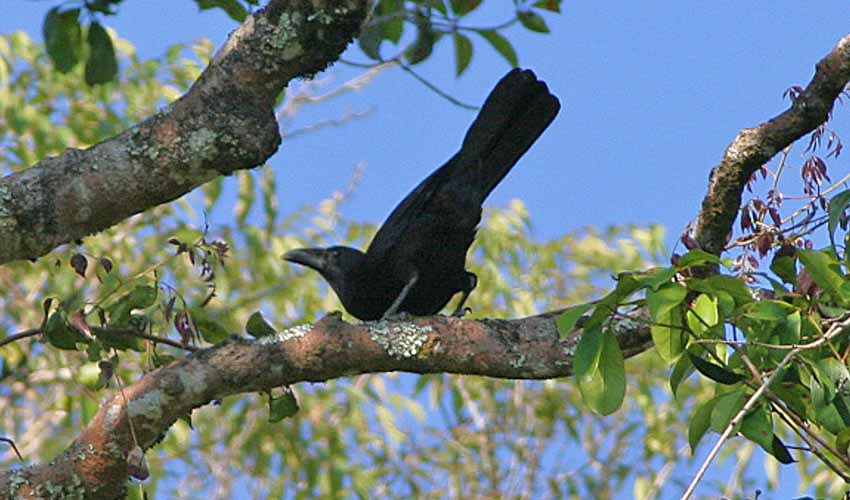
Compared with the big, bold city crows many people know, this one is more of a forest bird—shy, local, and tied to places where trees still form a thick, living roof. It’s often described as “rather diminutive” for a crow, with a slimmer build and a more delicate presence. In good light, it looks like a classic crow—dark overall with a strong bill—, but in the forest it can seem like a moving shadow, slipping through the canopy and edges where it can keep an eye on everything without being too exposed.
What makes the Flores crow especially interesting is how it fits into its island home. Flores has a mix of dry forest, moist lowland forest, and forest patches that change quickly with elevation and rainfall. The crow tends to favor remaining natural forest and older regrowth, where it can forage in trees and along forest edges. Like other crows, it’s an opportunist: it can eat a wide range of foods, including insects and other small animals, fruit, and whatever edible surprises it finds. That flexible diet is one reason crows have done well worldwide—but on Flores, flexibility has limits, because the bird’s biggest problem isn’t food variety; it’s the loss and break-up of the forest.
In behavior, the Flores crow is likely to feel familiar if you’ve watched crows elsewhere: it’s alert, intelligent, and always “checking” its surroundings. It may forage by walking along branches, investigating clusters of leaves, or dropping down to snag something from the ground before returning to cover. But it differs from many mainland crows in one big way—it’s an island specialist with a tiny range, and that makes it naturally uncommon. A widespread crow can simply spread out or shift habitats when conditions change; the Flores crow can’t. It is also sometimes confused with other dark crows in the region, which adds to its mystery.
Distribution
 Indonesia
Anything we've missed?
Help us improve this page by suggesting edits. Glory never dies!
Suggest an editGet to know me
Terrestrial / Aquatic
Altricial / Precocial
Polygamous / Monogamous
Dimorphic (size) / Monomorphic
Active: Diurnal / Nocturnal
Social behavior: Solitary / Pack / Herd
Diet: Carnivore / Herbivore / Omnivore / Piscivorous / Insectivore
Migratory: Yes / No
Domesticated: Yes / No
Dangerous: Yes / No




