


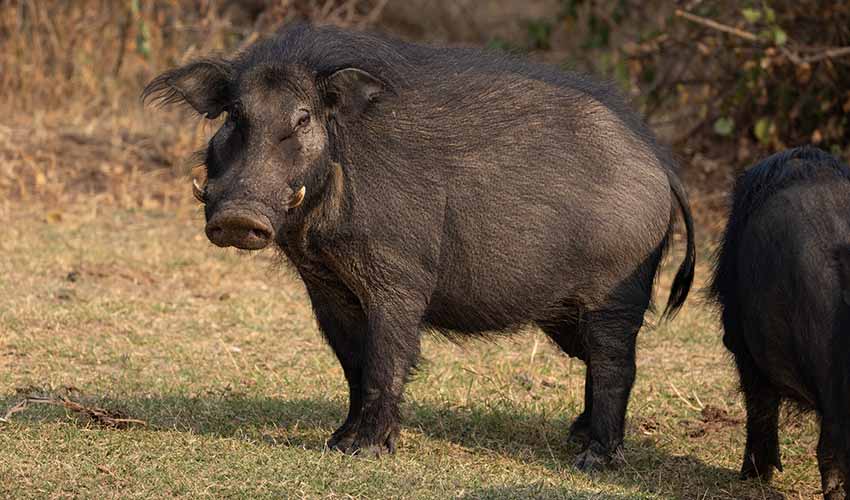
Found in dense forests, grasslands, and montane regions across Central and West Africa, this hog can weigh over 250 kilograms (550 pounds), making it far bulkier than the more familiar warthog. Its coarse black hair, massive head, and prominent facial pads make it both intimidating and impressive. Despite its size, it is surprisingly elusive, often disappearing into thick vegetation, which is why many people near its range have never seen one.
One of the most distinctive features of the Giant forest hog is its facial “warts” or pads, which are thick skin growths on the cheeks. These serve as protection during fights with rivals, especially males competing for mates. Add in their long, curved tusks and muscular build, and it’s easy to see why they’re considered the heavyweights of the pig world. But they aren’t just about power—they’re also intelligent and adaptable, living in environments where many other large mammals struggle.
Unlike solitary wild pigs, Giant forest hogs are social creatures, usually living in herds called sounders made up of females and their young, often led by a dominant male. They feed mainly on grasses, roots, fruits, and other vegetation, making them important grazers in their ecosystems. They’re also excellent ecosystem engineers: by rooting around for food, they help aerate the soil and spread seeds, creating new opportunities for plants to grow. Even though they might look rough and tough, they play a quiet but vital role in maintaining their environment.
Despite their bulk, they can run surprisingly fast when threatened, dashing into the safety of the forest. Their loud, deep grunts and squeals echo through the trees, earning them the reputation of being the “booming voices” of the forest. And though they look fierce, they’re generally shy around humans—preferring to stay hidden, which adds to their aura of mystery.
Distribution
 Cameroon
 Central Af. Rep.
 Congo-Brazzaville
 Côte D’ivoire
 DR Congo (Kinshasa)
 Equatorial Guinea
 Official estimate
 Ethiopia
 Gabon
Gabon Ghana
Ghana Guinea
 Kenya
Kenya Liberia
 Nigeria
 Rwanda
 Sierra Leone
 Sudan
Sudan Uganda
Anything we've missed?
Help us improve this page by suggesting edits. Glory never dies!
Suggest an editGet to know me
Terrestrial / Aquatic
Altricial / Precocial
Polygamous / Monogamous
Dimorphic (size) / Monomorphic
Active: Diurnal / Nocturnal
Social behavior: Solitary / Pack / Herd
Diet: Carnivore / Herbivore / Omnivore / Piscivorous / Insectivore
Migratory: Yes / No
Domesticated: Yes / No
Dangerous: Yes / No




