


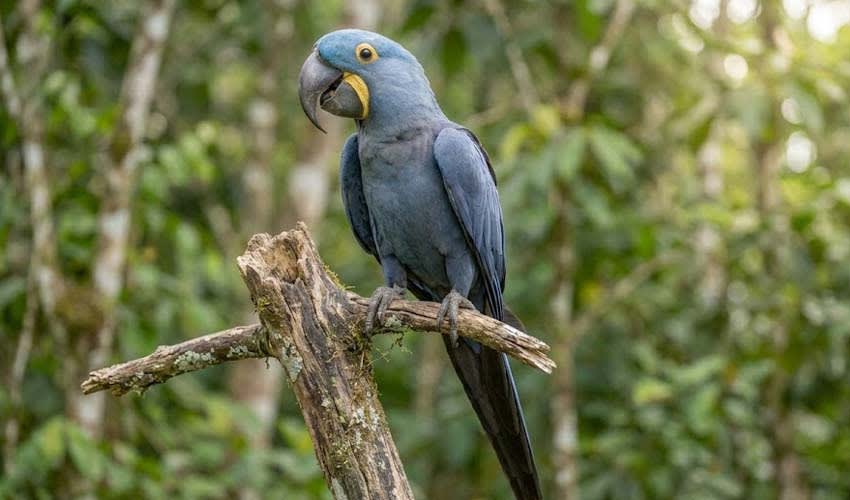
Once native to parts of South America, especially along rivers and in palm forests, this large macaw was admired for its soft blue-gray feathers, which gave it a calm, almost smoky appearance. Unlike the bright reds, yellows, or greens seen in many other macaws, the Glaucous macaw’s coloring was subtle and elegant. Its head and body were covered in pale bluish tones, while its wings were slightly darker, creating a gentle contrast. The bare skin around its eyes was yellow, adding a striking highlight to its face, and its strong black beak was perfectly shaped for cracking hard nuts.
What made the Glaucous macaw truly distinct from other macaws was not just its color, but also its lifestyle and habitat. It was closely tied to specific palm trees, especially those growing along rivers and in wetlands. These palms provided both food and nesting sites, making the macaw heavily dependent on a narrow range of environments. Compared to other macaws that could adapt to forests or open woodlands, the Glaucous macaw had a more limited range. This specialization made it unique, but also vulnerable. As palm groves were cleared and river habitats changed, the bird had fewer places to live and fewer food sources to rely on.
The Glaucous macaw was also known for its powerful flight and social nature. Like other macaws, it was believed to live in pairs or small groups, forming strong bonds with its mate. These birds were intelligent and curious, likely communicating with loud calls that echoed across riverbanks. Their voices were probably similar to other macaws—harsh and far-carrying—, but their presence was said to feel calmer due to their muted coloring. Early explorers described seeing them perched quietly in palm trees, blending almost perfectly with the sky and foliage, making them harder to spot than brighter macaws.
Distribution
 Argentina
 Brazil
 Paraguay
 Uruguay
Anything we've missed?
Help us improve this page by suggesting edits. Glory never dies!
Suggest an editGet to know me
Terrestrial / Aquatic
Altricial / Precocial
Polygamous / Monogamous
Dimorphic (size) / Monomorphic
Active: Diurnal / Nocturnal
Social behavior: Solitary / Pack / Herd
Diet: Carnivore / Granivore / Omnivore / Piscivorous / Insectivore
Migratory: Yes / No
Domesticated: Yes / No
Dangerous: Yes / No




