


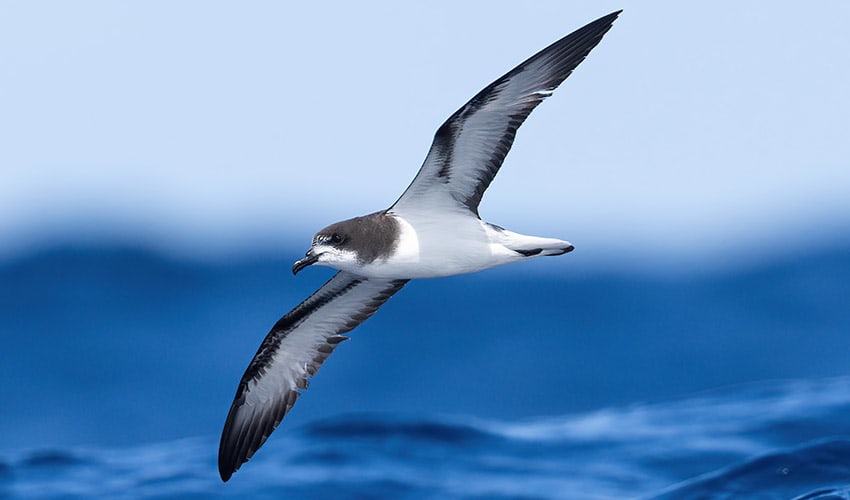
A sleek, long-winged seabird that feels almost like a piece of the ocean sky—appearing suddenly over waves, then vanishing just as quickly. It has a crisp, high-contrast look: a pale face and underparts paired with darker wings and back, giving it a clean “black-and-white” style that stands out when the light hits it right. Built for life over open water, it flies with quick wingbeats and smooth glides, often skimming low above the sea as if following invisible pathways in the wind. Most of the time, it is far from people, roaming wide areas of ocean in search of food, and only returning to land for one purpose: raising a chick.
Instead of nesting in trees or open ground, Gould’s petrel breeds in burrows and rocky spaces on islands and coastal headlands. It is most active around its nesting areas at night, which helps it avoid daytime danger and gives it an almost secretive personality. If you’ve ever heard the night calls of seabirds, you’ll understand the mood: petrels can sound surprisingly eerie after dark, turning a quiet hillside into a lively chorus you’d never guess was there in daylight.
At sea, Gould’s petrel lives on a diet of small fish and squid, and it finds them by patrolling productive waters until the timing is right. It may feed alone or in loose company with other seabirds, taking advantage of food pushed toward the surface by currents and bigger hunters below. Like many petrels, it’s a master of long-distance efficiency—covering huge stretches of ocean without wasting energy.
Distribution
 American Samoa
 Antarctica
 Australia
 Cook Islands
 Ecuador
 Fiji
Fiji French Polynesia
 Kiribati
 New Caledonia
 New Zealand
 Niue
Niue Norfolk Island
 Peru
Peru Pitcairn
 Samoa
Samoa Tokelau
 Tonga
Tonga Tuvalu
 US Minor Is.
 Vanuatu
 Wallis & Futuna
Anything we've missed?
Help us improve this page by suggesting edits. Glory never dies!
Suggest an editGet to know me
Terrestrial / Aquatic
Altricial / Precocial
Polygamous / Monogamous
Dimorphic (size) / Monomorphic
Active: Diurnal / Nocturnal
Social behavior: Solitary / Pack / Herd
Diet: Carnivore / Herbivore / Omnivore / Piscivorous / Insectivore
Migratory: Yes / No
Domesticated: Yes / No
Dangerous: Yes / No




