


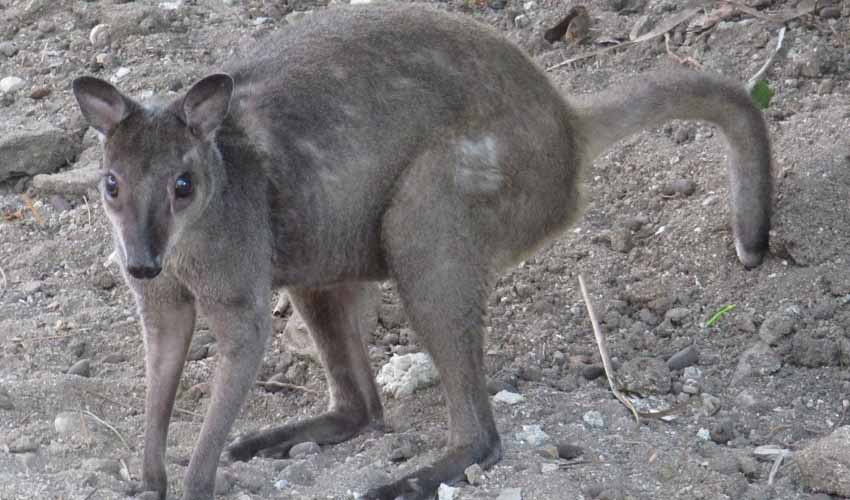
At a glance, it looks like it was designed for shade: its coat is a smoky gray on top and paler underneath, the kind of coloring that melts into tree trunks, dim understory light, and misty forest edges. It has a long muzzle and small, rounded ears, giving it a more “quiet woodland” look than the sharper, open-country faces of many wallabies. Its tail is long and ends in a tough, bare tip, like a built-in bumper for life spent moving through plants, over roots, and along forest tracks.
Compared with many kangaroo-family animals that seem “all legs,” the gray dorcopsis has forelegs that are relatively longer than you’d expect, giving it a more balanced, sturdy build. That matters in thick habitat: longer forelimbs help it brace, shuffle, and push through tangled plants rather than relying only on long, bounding leaps. Another standout feature is how dramatically males and females can differ in size—males can be much heavier and longer than females, making this species one of those animals where you might see two individuals and assume they’re different species until you look closely. There’s also an odd little detail that feels very “field guide”: a yellowish patch of fur around its single body opening under the tail, which can be a useful clue for identification.
Its lifestyle matches its look: the gray dorcopsis is a forest specialist that tends to stay in or near cover. It lives in primary and secondary tropical forests, often favoring places like gallery forests (the green corridors along rivers and streams), and it can also show up in disturbed areas such as abandoned gardens—basically anywhere that offers food and hiding spots.
Distribution
 Indonesia
 Papua New Guinea
Anything we've missed?
Help us improve this page by suggesting edits. Glory never dies!
Suggest an editGet to know me
Terrestrial / Aquatic
Altricial / Precocial
Polygamous / Monogamous
Dimorphic (size) / Monomorphic
Active: Diurnal / Nocturnal
Social behavior: Solitary / Pack / Herd
Diet: Carnivore / Herbivore / Omnivore / Piscivorous / Insectivore
Migratory: Yes / No
Domesticated: Yes / No
Dangerous: Yes / No




