


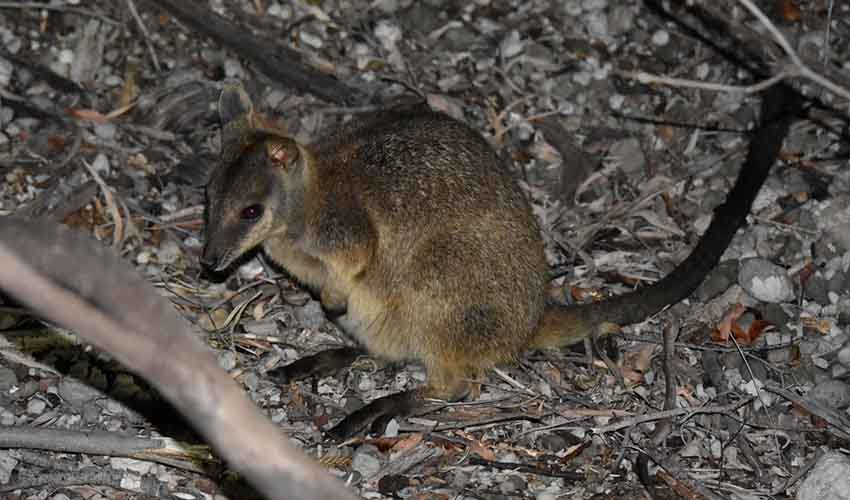
While some rock-wallabies have bold face stripes, bright patches, or dramatic color contrasts, this one is more plain and understated—hence “unadorned.” Its coat is usually a soft gray-brown to sandy-brown, designed to melt into sunlit granite, shadowy crevices, and dusty ledges. It lives in rocky hills and escarpments, especially along rainforest edges and in woodland in parts of Queensland, where boulder piles and steep slopes offer both shelter and a quick escape route. Like all rock-wallabies, it’s built for tricky terrain: strong back legs for springy jumps, forepaws that can brace against rock, and a long tail that works like a balancing pole when it lands on uneven surfaces.
Rock-wallabies can be surprisingly hard to tell apart because many are similar in size and shape, so small details matter. The unadorned rock-wallaby tends to lack the showy facial markings and high-contrast striping seen in several other species, giving it a cleaner, more uniform appearance. Its coloring is less about being eye-catching and more about being hard to notice, especially when it freezes against rock. It also fits a particular slice of Australia: rather than being spread across huge stretches of desert ranges, it’s tied to specific rocky habitats in the northeast, where steep, broken country meets greener forested areas.
Daily life for an unadorned rock-wallaby is a careful routine of hiding, feeding, and using the landscape like a fortress. During the day, it often rests in cool caves, cracks, and shaded overhangs, where the temperature can be noticeably lower than the open slope outside. When the light softens—late afternoon into evening—it may venture out to browse on grasses, leaves, and small shrubs, usually staying close enough to the rocks that it can retreat fast if startled. If danger appears, it doesn’t need to outrun anything across open ground; it needs to reach the nearest maze of boulders.
Distribution
 Australia
Anything we've missed?
Help us improve this page by suggesting edits. Glory never dies!
Suggest an editGet to know me
Terrestrial / Aquatic
Altricial / Precocial
Polygamous / Monogamous
Dimorphic (size) / Monomorphic
Active: Diurnal / Nocturnal
Social behavior: Solitary / Pack / Herd
Diet: Carnivore / Herbivore / Omnivore / Piscivorous / Insectivore
Migratory: Yes / No
Domesticated: Yes / No
Dangerous: Yes / No




