


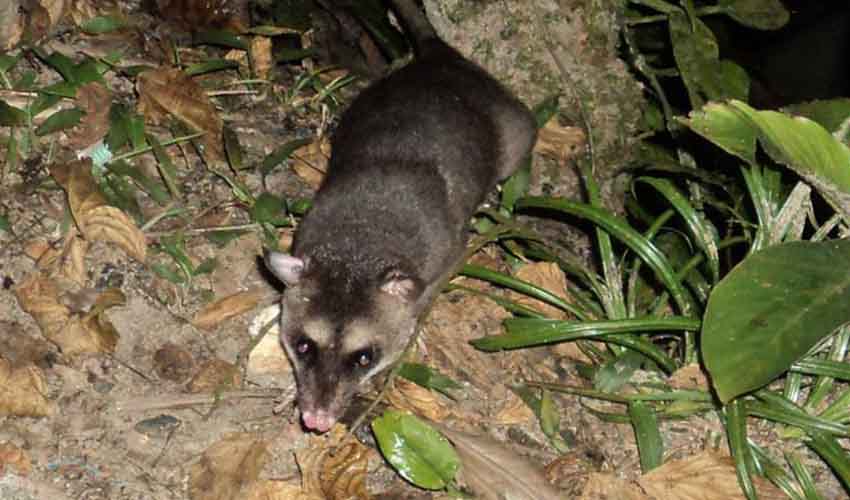
Those spots are the reason it’s called “four-eyed,” and they give it a face that’s surprisingly easy to recognize once you know what to look for. It has a slim, agile body, a pointed snout, alert ears, and a long tail that helps it balance while climbing. Its coat is usually gray on the back and sides with a much paler underside, creating a neat two-tone look that blends well with bark, leaf litter, and shadowy understory. When it moves, it often does so quietly and cautiously—sniffing, pausing, listening—like an animal that understands the forest is full of eyes and ears after dark.
What distinguishes the gray four-eyed opossum from many other opossums is its “in-between” lifestyle: not purely a tree creature and not purely a ground forager, but a flexible traveler that uses whatever level of the forest is most useful. It can climb confidently, but it also spends time on the ground, moving along logs, trails, and forest edges where food can be easier to find. Compared with larger, tougher-looking opossums that people often imagine rummaging in open spaces, the gray four-eyed opossum looks more streamlined and “wild-forest” in character—built for stealth rather than swagger. Its tail often shows a noticeable shift in color—darker near the base and lighter toward the end—adding another visual clue when it’s moving through vegetation.
Its daily routine is mostly nocturnal, so the gray four-eyed opossum becomes active when the forest cools and shadows deepen. It’s an opportunistic eater with a wide menu. Fruit is a common choice when available, but it also eats insects and other small prey it can catch, and it won’t ignore easy meals if it stumbles onto them. That flexibility is a big survival advantage in environments where the “best” food changes with season and weather. It usually forages with a careful rhythm: short movements, frequent pauses, lots of sniffing and listening, then a quick grab if it finds something worth eating.
Distribution
 Argentina
 Belize
 Bolivia
 Brazil
 Colombia
 Costa Rica
 Ecuador
 El Salvador
 French Guiana
 Guatemala
 Guyana
 Honduras
 Mexico
 Nicaragua
 Panama
 Paraguay
 Peru
Peru Suriname
 Venezuela
Anything we've missed?
Help us improve this page by suggesting edits. Glory never dies!
Suggest an editGet to know me
Terrestrial / Aquatic
Altricial / Precocial
Polygamous / Monogamous
Dimorphic (size) / Monomorphic
Active: Diurnal / Nocturnal
Social behavior: Solitary / Pack / Herd
Diet: Carnivore / Herbivore / Omnivore / Piscivorous / Insectivore
Migratory: Yes / No
Domesticated: Yes / No
Dangerous: Yes / No




