


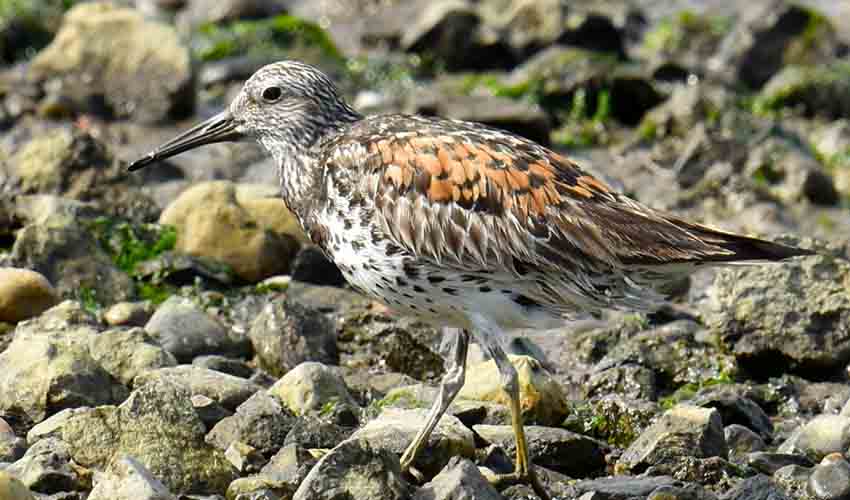
A sturdy, long-winged shorebird that looks built for endurance. It’s slightly bigger and bulkier than many of the “little sandpipers” people see on beaches, with a thicker chest, a fairly straight dark bill, and legs that often look greenish or gray. In the non-breeding season, it wears a calm, pale outfit—mostly gray-brown above and white below—so it can blend into wide tidal flats. But in breeding season, it transforms into something far more dramatic: the underparts become heavily marked with black, and the face and chest take on warmer tones, giving it a bold, speckled look that stands out among flocks. One of its best features is its shape in flight: long, pointed wings and a strong, direct style that hints at the marathon journeys it’s famous for.
Compared with the red knot, which is often rounder-looking and can show a richer, more even reddish color in breeding season, the great knot tends to look more heavily “inked” underneath, with stronger dark markings and a slightly more serious, patterned appearance. Against smaller sandpipers, it often seems thicker-necked and more powerfully built, like the “heavyweight” in a lineup. When feeding, it has a steady, businesslike manner—walking with purpose, probing, and picking rather than sprinting in quick bursts.
The great knot’s life story is one of the most impressive long-distance routines in the bird world. It breeds far north in the Arctic and then travels to warmer coasts for the rest of the year, often gathering in huge numbers on tidal flats in Asia and Australia. These stopover sites are like essential “fuel stations,” because the bird has to pack on energy quickly before continuing its journey. When it arrives, it becomes a focused eater, taking advantage of what mudflats offer—especially small shellfish and other tiny sea creatures that live just under the surface.
Distribution
 Afghanistan
 Australia
 Azerbaijan
 Bahrain
 Bangladesh
 Bhutan
 Brunei
 Cambodia
 China
China Christmas Island
 Cocos Is. (Keeling)
 Denmark
 Djibouti
 East Timor
 Germany
 Guam
Guam Hong Kong
 India
India Indonesia
 Iran
Iran Iraq
Iraq Ireland
 Israel
 Japan
Japan Kazakhstan
 Korea
Korea Kuwait
 Kyrgyzstan
 Laos
Laos Macao
Macao Malaysia
 Mauritius
 Micronesia
 Mongolia
 Morocco
 Myanmar
 Nepal
Nepal Netherlands
 New Caledonia
 New Zealand
 Nort. Mariana Is.
 North Korea
 Norway
 Oman
Oman Pakistan
 Palau
Palau Papua New Guinea
 Philippines
 Qatar
Qatar Russia
 Saudi Arabia
 Seychelles
 Singapore
 Spain
Spain Sri Lanka
 Taiwan
 Thailand
 UAE
UAE US Minor Is.
 United Kingdom
 United States
 Uzbekistan
 Vietnam
 Yemen
YemenAnything we've missed?
Help us improve this page by suggesting edits. Glory never dies!
Suggest an editGet to know me
Terrestrial / Aquatic
Altricial / Precocial
Polygamous / Monogamous
Dimorphic (size) / Monomorphic
Active: Diurnal / Nocturnal
Social behavior: Solitary / Pack / Flock
Diet: Carnivore / Herbivore / Omnivore / Piscivorous / Insectivore
Migratory: Yes / No
Domesticated: Yes / No
Dangerous: Yes / No




