


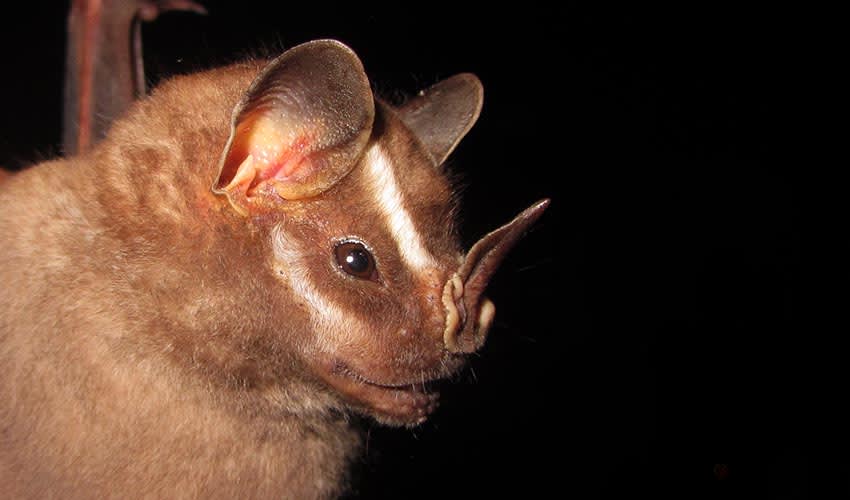
Found throughout Central and South America, from southern Mexico and the Caribbean down to northern Argentina, this bat is a nocturnal rainforest gardener. Its most distinguishing feature is, as its name suggests, the bold white or cream-colored stripes running from above its eyes down to its neck, creating a mask-like pattern that gives it a dramatic, almost superhero-like appearance. Its fur is soft and short, usually dark brown to reddish-brown, and contrasts sharply with its facial stripes and pale belly.
Another signature feature is its large leaf-shaped nose, a hallmark of the leaf-nosed bat family (Phyllostomidae), which helps it navigate and find food using echolocation. The great stripe-faced bat also has long, narrow wings for agile flight through the forest canopy and a remarkably long tail membrane that aids in stability and maneuverability. Its large, bright eyes and expressive face make it one of the most easily recognizable bats in the Neotropics.
The great stripe-faced bat is primarily frugivorous, meaning it feeds on fruit, though it occasionally consumes nectar and insects. Its diet consists largely of figs, guavas, bananas, and other soft tropical fruits, which it often picks and carries to a nearby perch to eat. There, it uses its sharp teeth to bite through the fruit and consume the pulp, discarding the seeds, which later germinate to produce new trees. This feeding behavior makes the bat a key seed disperser, helping regenerate tropical forests and maintain biodiversity.
Behaviorally, the great stripe-faced bat is nocturnal and generally solitary, though it sometimes roosts in small family groups or pairs. During the day, it takes refuge in tree hollows, abandoned bird nests, or dense foliage, often choosing roosting spots well-hidden from predators.
At night, it emerges to feed, flying gracefully and quietly through the canopy. Unlike insectivorous bats, which rely heavily on high-frequency echolocation, the great stripe-faced bat uses lower-pitched sounds combined with its excellent vision and sense of smell to locate ripe fruit.
Distribution
 Bolivia
 Brazil
 Colombia
 Ecuador
 French Guiana
 Guatemala
 Guyana
 Peru
Peru Suriname
 Trinidad & Tobago
 Venezuela
Anything we've missed?
Help us improve this page by suggesting edits. Glory never dies!
Suggest an editGet to know me
Terrestrial / Aquatic
Altricial / Precocial
Polygamous / Monogamous
Dimorphic (size) / Monomorphic
Active: Diurnal / Nocturnal
Social behavior: Solitary / Pack / Colony
Diet: Carnivore / Frugivore / Omnivore / Piscivorous / Insectivore
Migratory: Yes / No
Domesticated: Yes / No
Dangerous: Yes / No




