


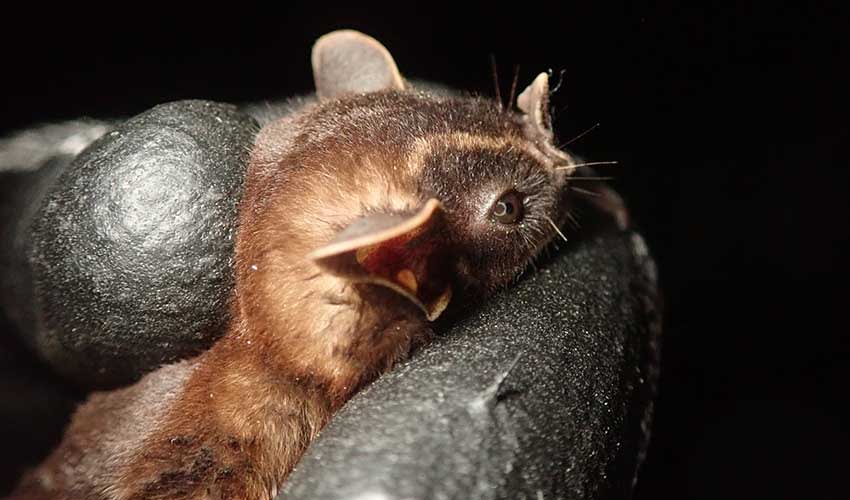
One of the lesser-known but most charming bats of the Neotropics, celebrated for its silky, velvety fur, striking facial features, and vital role as a seed disperser in tropical ecosystems. Found across parts of Central and South America, from southern Mexico and the Caribbean to Bolivia and northern Brazil, this beautiful little bat lives in the lush rainforests, cloud forests, and fruit-rich lowlands of the region.
Physically, the velvety fruit-eating bat is small but strikingly elegant. Its name comes from its luxuriously soft, velvety fur, which is usually a rich dark brown or grayish-black, sometimes with a silvery sheen under light. The bat’s face is rounded and expressive, with large, dark eyes and a short, broad snout crowned by a distinctive leaf-shaped nose used in echolocation. Its ears are small and slightly pointed, and its wings are broad and flexible—perfect for slow, maneuverable flight through dense vegetation. Compared to many other fruit bats, it has a more compact body and gentler facial features, giving it a particularly endearing, almost plush-toy appearance.
As its name suggests, the velvety fruit-eating bat is frugivorous, meaning it feeds primarily on fruit, but it will occasionally consume flowers, nectar, or leaves depending on availability. Its favorite foods include figs, guavas, bananas, and other soft, sweet fruits commonly found in tropical forests. Using its strong jaws and sharp teeth, it bites into fruit to extract the pulp and juice, often carrying its meal to a nearby perch to eat in peace. Once finished, it drops the seeds far from the parent tree, effectively planting new life throughout the forest. In doing so, the bat acts as a natural reforester, ensuring that tropical plants continue to thrive and regenerate. Its digestive system is highly efficient—fruit can pass through in as little as 20 minutes, allowing the bat to cover long distances each night while scattering seeds over a wide area.
Distribution
 Bolivia
 Colombia
 Costa Rica
 Ecuador
 El Salvador
 Guatemala
 Honduras
 Mexico
 Panama
 Peru
Peru United States
 Venezuela
Anything we've missed?
Help us improve this page by suggesting edits. Glory never dies!
Suggest an editGet to know me
Terrestrial / Aquatic
Altricial / Precocial
Polygamous / Monogamous
Dimorphic (size) / Monomorphic
Active: Diurnal / Nocturnal
Social behavior: Solitary / Pack / Colony
Diet: Carnivore / Frugivore / Omnivore / Piscivorous / Insectivore
Migratory: Yes / No
Domesticated: Yes / No
Dangerous: Yes / No




