


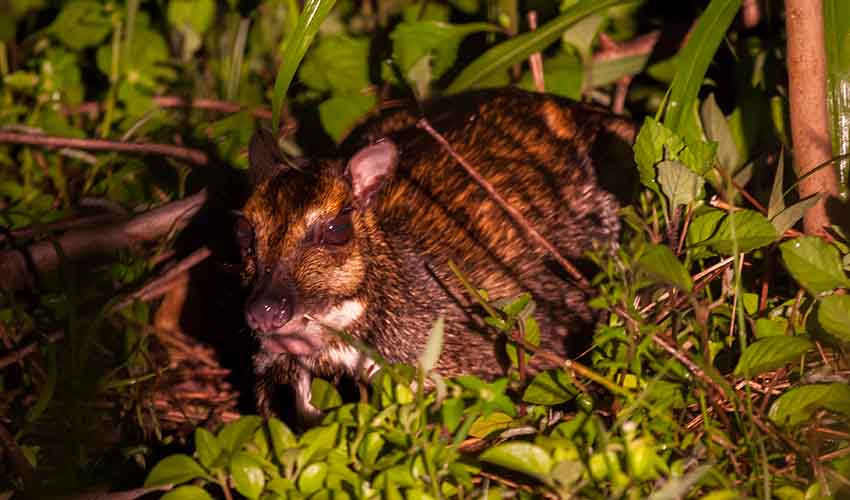
Despite its name, it isn’t a deer at all, though it does share a similar body shape. It has slim legs, a rounded back, and a delicate face with large, watchful eyes. What makes it instantly stand out is its size. The greater mouse-deer is the largest of all mouse-deer, about as big as a medium-sized dog, which clearly sets it apart from its much smaller relatives. Its coat is smooth and reddish-brown, often marked with pale stripes or spots that help it blend into the forest shadows.
One of the most surprising characteristics of the greater mouse-deer is what it lacks and what it has in its place. Unlike true deer, it has no antlers. Males make up for this absence with sharp, fang-like teeth that curve downward from the upper jaw. These tusks are used mainly in displays and scuffles with rivals rather than for feeding, giving the animal a slightly “vampire” look that fascinates many people. Compared with other mouse-deer, the greater mouse-deer has longer legs and a sturdier body, which helps it move more confidently through dense forest undergrowth and along riverbanks
What really distinguishes the greater mouse-deer from other mouse-deer is its behavior and presence. It tends to be more solitary and territorial, quietly claiming patches of forest as its own. While smaller mouse-deer often dart nervously from cover to cover, the greater mouse-deer shows a bit more boldness, sometimes standing its ground before making a sudden escape. It is mostly active at night, using its sharp hearing and sense of smell to stay alert. When startled, it may stomp the ground or freeze completely, relying on its camouflage to avoid being seen. This mix of caution and confidence gives it a personality that feels both timid and brave.
Distribution
 Brunei
 Indonesia
 Malaysia
 Myanmar
 Singapore
 Thailand
Anything we've missed?
Help us improve this page by suggesting edits. Glory never dies!
Suggest an editGet to know me
Terrestrial / Aquatic
Altricial / Precocial
Polygamous / Monogamous
Dimorphic (size) / Monomorphic
Active: Diurnal / Nocturnal
Social behavior: Solitary / Pack / Herd
Diet: Carnivore / Herbivore / Omnivore / Piscivorous / Insectivore
Migratory: Yes / No
Domesticated: Yes / No
Dangerous: Yes / No




