


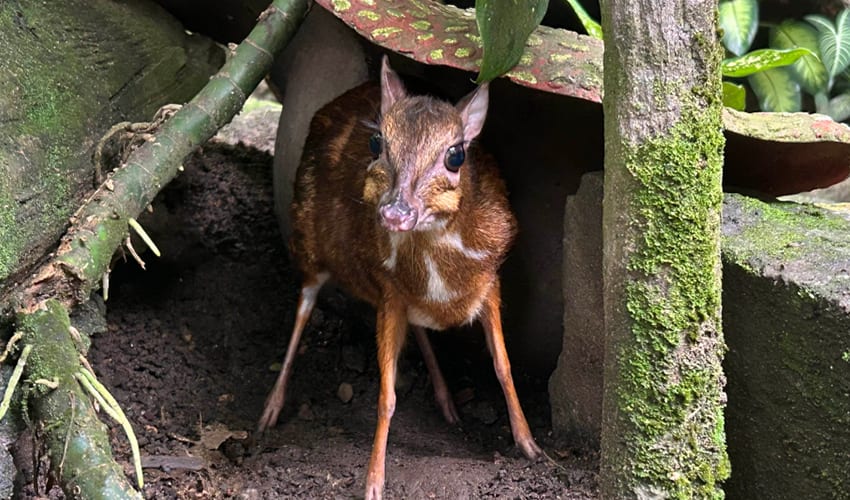
One of the smallest hoofed mammals on Earth, and it feels like a deer scaled down to the size of a house cat. It has a delicate, narrow face, big dark eyes, and a smooth, reddish-brown coat that helps it vanish into leaf litter and shadow. Its legs are thin and fine-boned, and it moves with quick, careful steps—more like a cautious forest mouse than a grassland deer. Even its feet are tiny, ending in little hooves that click softly on roots and fallen branches. It doesn’t have antlers, and it doesn’t look built for long chases; instead, its superpower is staying hidden, freezing when danger is near, and slipping away through dense undergrowth.
What really distinguishes the lesser mouse-deer from true deer is that it isn’t actually a deer at all. It belongs to a much older, smaller branch of hoofed mammals called chevrotains, sometimes described as living reminders of what early hoofed animals may have been like. In appearance and behavior, it has its own style: the body is rounded and compact, the neck is not as long as that of many deer, and the tail is short. Males have small, sharp canine teeth that can peek out like tiny tusks, which is a surprising detail on such a gentle-looking creature.
The lesser mouse-deer lives in the lowland forests of Southeast Asia, spending most of its time under cover. It is mainly active at night or in dim light, when shadows are thick, and predators have a harder time spotting it. Instead of grazing in open meadows, it forages in the understory, nibbling fallen fruit, leaves, shoots, and other small bits of plant food it can find close to the ground. It often uses the same narrow paths through vegetation again and again, like secret tunnels through the forest. When threatened, it may freeze completely, relying on stillness and camouflage, or it may explode into a sudden sprint and then stop just as suddenly, making it hard to track.
Distribution
 Brunei
 Cambodia
 China
China Indonesia
 Laos
Laos Malaysia
 Myanmar
 Singapore
 Thailand
 Vietnam
Anything we've missed?
Help us improve this page by suggesting edits. Glory never dies!
Suggest an editGet to know me
Terrestrial / Aquatic
Altricial / Precocial
Polygamous / Monogamous
Dimorphic (size) / Monomorphic
Active: Diurnal / Nocturnal
Social behavior: Solitary / Pack / Herd
Diet: Carnivore / Frugivore / Omnivore / Piscivorous / Insectivore
Migratory: Yes / No
Domesticated: Yes / No
Dangerous: Yes / No




