


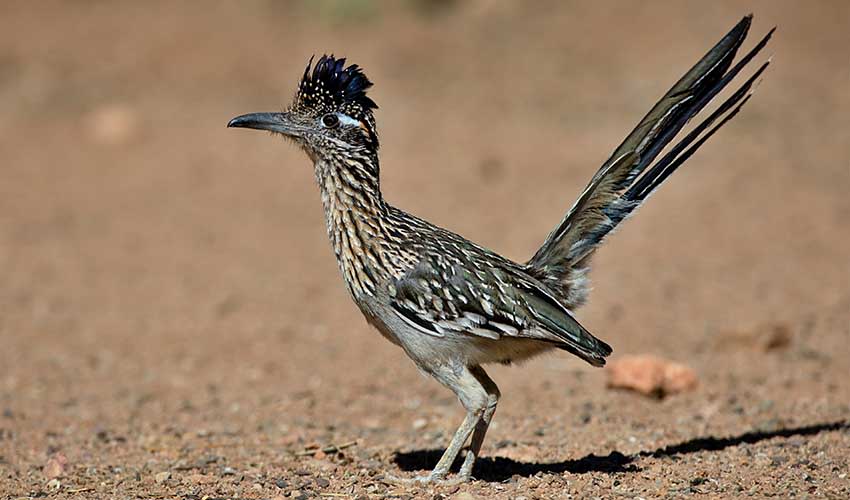
One of North America’s most iconic and entertaining birds—a true symbol of the desert Southwest. Known for its lightning-fast legs, curious personality, and pop culture fame as the “beep-beep” speedster from Looney Tunes, this real-life bird is every bit as fascinating as its cartoon counterpart—just a little quieter, cooler, and a whole lot smarter.
Unlike its tree-dwelling relatives, the greater roadrunner prefers life on the ground. It’s built for speed and stealth, with a long tail, strong legs, and a lean, aerodynamic body designed for running rather than flying. Its feathers are a mix of browns, blacks, and whites, giving it a camouflaged, desert-toned appearance that helps it blend into scrub and sand. The bird’s most striking features are its shaggy crest—which it raises when excited—and its long, expressive tail, which it flicks and fans for balance during its high-speed chases.
And fast it is: the greater roadrunner can sprint at up to 32 kilometers (20 miles) per hour, easily outrunning lizards, snakes, and even startled humans. It’s a carnivorous opportunist, eating anything it can catch—insects, scorpions, frogs, small mammals, birds, and reptiles, even small rattlesnakes. It’s been known to work in pairs to take down larger prey, using quick teamwork and lightning reflexes. Though it can fly short distances, it much prefers to stay grounded, zigzagging across the desert floor with grace and speed that put its animated version to shame.
The greater roadrunner is a master of desert survival. It thrives in hot, arid environments across the American Southwest, from California and Texas to northern Mexico. During cold desert mornings, it warms up by spreading its wings and exposing dark patches of skin along its back to absorb the sun’s heat—a natural solar panel. When temperatures soar, it conserves water by excreting salt through glands near its eyes, much like a seabird. It’s one of the few animals so perfectly adapted to desert extremes, living where many species can’t survive.
Distribution
 Mexico
 United States
Anything we've missed?
Help us improve this page by suggesting edits. Glory never dies!
Suggest an editGet to know me
Terrestrial / Aquatic
Altricial / Precocial
Polygamous / Monogamous
Dimorphic (size) / Monomorphic
Active: Diurnal / Nocturnal
Social behavior: Solitary / Pack / Herd
Diet: Carnivore / Herbivore / Omnivore / Piscivorous / Insectivore
Migratory: Yes / No
Domesticated: Yes / No
Dangerous: Yes / No




