


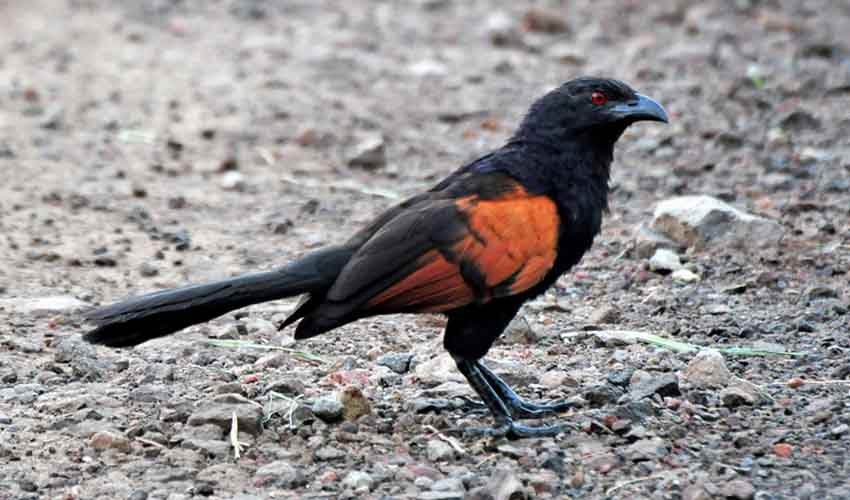
A chunky, long-tailed member of the cuckoo family that feels more like a marsh stalker than a typical cuckoo. It is endemic to Java, Indonesia, meaning it naturally occurs there and nowhere else, and it is strongly tied to wet, lowland habitats. Unlike many cuckoos associated with forests or open woodland, the Sunda coucal prefers places with thick, tangled vegetation that is often damp. You’re most likely to find it in mangroves, freshwater swamp forest, reedbeds, wet grasslands, and marshy edges of rice fields, especially near brackish or slow-moving water.
In appearance, the Sunda coucal looks powerful and serious. It has a strong black bill, sturdy legs, and a long tail that helps it balance as it moves through dense plants. Its plumage is bold but simple: most of the body is dark, almost black, while the wings are a rich chestnut brown. When the bird shifts position or takes a short flight, those warm-colored wings flash against the darker body, making it surprisingly eye-catching. Its eyes are often described as reddish, giving it an intense, alert expression that adds to its “no-nonsense” look.
The Sunda coucal spends most of its time low to the ground. Instead of flying frequently, it prefers to walk, hop, and clamber through vegetation, using short bursts of flight only when needed. It is a skilled hunter with a broad diet. Insects make up a large part of its food, including grasshoppers, beetles, and moths, but it doesn’t stop there. It also eats frogs, lizards, small snakes, and other small animals it can overpower. In agricultural areas, it has even been seen picking up rice seeds, showing that it can be flexible when food is easy to find.
Distribution
 Indonesia
 Official estimate
Anything we've missed?
Help us improve this page by suggesting edits. Glory never dies!
Suggest an editGet to know me
Terrestrial / Aquatic
Altricial / Precocial
Polygamous / Monogamous
Dimorphic (size) / Monomorphic
Active: Diurnal / Nocturnal
Social behavior: Solitary / Pack / Herd
Diet: Carnivore / Herbivore / Omnivore / Piscivorous / Insectivore
Migratory: Yes / No
Domesticated: Yes / No
Dangerous: Yes / No




