


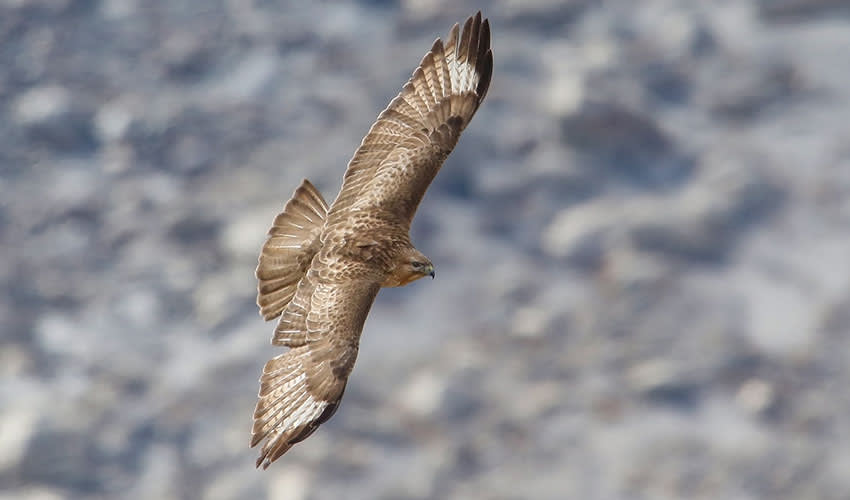
A large and impressive bird of prey that lives across the high mountains, open valleys, and forest edges of the Himalayan region and nearby parts of Central and East Asia. It is a powerful flyer, often seen soaring high in the sky on broad wings, using rising air currents to travel long distances with little effort. Its appearance is variable, but it is usually brown with lighter underparts and dark markings on the wings.
One of the most distinctive features of the Himalayan buzzard is its ability to adapt to different environments and elevations. Unlike many birds of prey that are limited to specific habitats, this buzzard can be found from low valleys to high mountain slopes. It often perches on rocks, cliffs, or trees while scanning the ground for prey. Its eyesight is excellent, allowing it to spot movement from far above. When hunting, it typically drops down in a smooth, controlled dive rather than chasing prey over long distances.
What sets the Himalayan buzzard apart from other buzzards is its size, range, and seasonal movements. It is generally larger and heavier than many related buzzard species, which helps it survive colder climates. During certain times of the year, some Himalayan buzzards move to lower elevations or warmer regions, especially in winter. This partial migration allows them to find food even when snow covers the ground in higher areas. Compared to similar species, it has a deeper, slower wingbeat and a more commanding presence in flight.
The Himalayan buzzard feeds mainly on small mammals such as rodents, but it also eats birds, reptiles, and insects when available. This varied diet makes it an important part of the ecosystem, helping control populations of animals that might otherwise grow too large. It is often seen alone or in pairs, though several individuals may gather in areas with plentiful food. Its call is a sharp, clear cry sometimes heard as it circles high above its territory.
Distribution
 Bhutan
 China
China India
India Nepal
Nepal Pakistan
Anything we've missed?
Help us improve this page by suggesting edits. Glory never dies!
Suggest an editGet to know me
Terrestrial / Aquatic
Altricial / Precocial
Polygamous / Monogamous
Dimorphic (size) / Monomorphic
Active: Diurnal / Nocturnal
Social behavior: Solitary / Pack / Herd
Diet: Carnivore / Herbivore / Omnivore / Piscivorous / Insectivore
Migratory: Yes / No
Domesticated: Yes / No
Dangerous: Yes / No




