


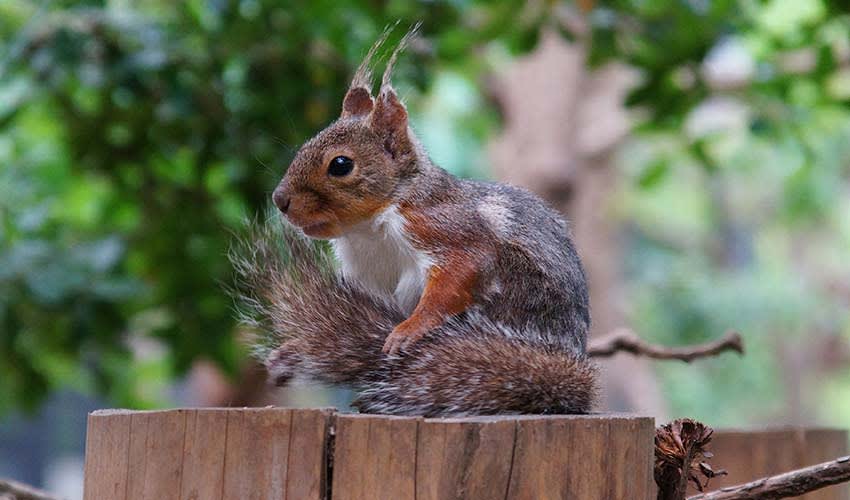
A charming tree squirrel found only in Japan, which makes it special right away. It lives mainly on the islands of Honshu, Shikoku, and Kyushu, where it can be found in forests, wooded hills, and sometimes parks or gardens with enough trees. It has a neat, compact body, bright eyes, small, rounded ears, and a long, bushy tail that helps it balance while climbing. Its fur is usually grayish-brown or reddish-brown on the back, with a pale belly. In colder months, its coat can become thicker and softer, helping it stay warm in Japan’s changing seasons.
One thing that makes the Japanese squirrel different from many other squirrels is its strong connection to Japan’s native woodlands. Unlike squirrels that spread widely across many countries or thrive mainly in cities, this species is closely tied to Japanese forests with trees such as walnuts, oaks, pines, and chestnuts. It spends much of its time in trees, leaping between branches and using its sharp claws to cling to bark. It is active during the day, especially in the morning and afternoon, when it searches for food. Its tail works like a balancing pole, a warm blanket, and a signal flag when it is alert or excited.
The Japanese squirrel eats nuts, seeds, fruits, flowers, buds, fungi, and sometimes bark or insects. Like many tree squirrels, it hides food for later, especially in autumn when nuts are plentiful. Some of the seeds it forgets may grow into new trees, making it a small but important forest helper. This food-storing habit helps it survive winter, when fresh food is harder to find. Compared with more tropical squirrels that live in warm forests all year, the Japanese squirrel is well adapted to seasonal changes, shifting its behavior as food and weather change.
Distribution
 Japan
JapanAnything we've missed?
Help us improve this page by suggesting edits. Glory never dies!
Suggest an editGet to know me
Terrestrial / Aquatic
Altricial / Precocial
Polygamous / Monogamous
Dimorphic (size) / Monomorphic
Active: Diurnal / Nocturnal
Social behavior: Solitary / Pack / Herd
Diet: Carnivore / Herbivore / Omnivore / Piscivorous / Insectivore
Migratory: Yes / No
Domesticated: Yes / No
Dangerous: Yes / No




