


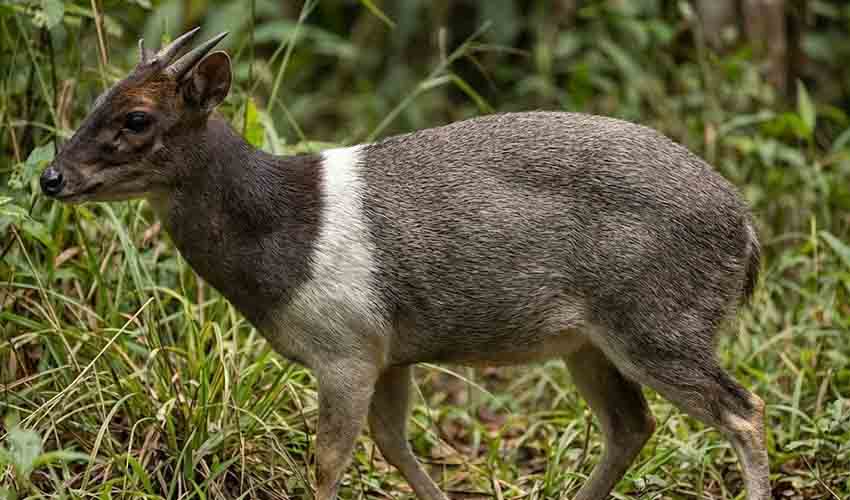
Picture a small, compact antelope about knee-high, with a smooth, reddish coat that can look like polished copper in a sunbeam—then imagine it disappearing the moment you blink. That warm “bay” color is one of its most distinctive features, and it helps it blend into the dim, leaf-strewn forest floor where reddish-brown light and shadows dominate. Its body is built like a quiet little athlete: short legs for quick bursts, a rounded shape that slips through tangles of vines, and a small head that can thread past branches without making much noise. Males usually have short, straight horns, while females often don’t, so the “horned” look is not always a given with this species.
What makes the bay duiker stand out from other duikers isn’t only its color—it’s also its strong preference for deep, thick rainforest and its talent for staying hidden. Some duiker relatives are more flexible, living near forest edges or mixed habitats, but the bay duiker is a true lover of dense cover. It tends to move along sheltered paths and keeps close to places where it can vanish fast. Even its behavior fits the stealth theme: instead of always sprinting away, it may freeze perfectly still, trusting that stillness and shade are better shields than speed. This is one reason people often learn about bay duikers through remote cameras rather than by spotting them during a walk. It’s not that they’re necessarily rare everywhere they live—it’s that they’re masters of not being noticed.
The bay duiker’s diet adds another layer of charm, because it behaves like a tidy forest neighbor. It often eats fallen fruit, leaves, buds, and even fungi, taking advantage of whatever the rainforest offers. If you think of the forest floor as a busy kitchen, the bay duiker is one of the diners that shows up after the main rush, nibbling what drops and helping keep things from piling up.
Distribution
 Côte D’ivoire
 Guinea
 Liberia
 Sierra Leone
Anything we've missed?
Help us improve this page by suggesting edits. Glory never dies!
Suggest an editGet to know me
Terrestrial / Aquatic
Altricial / Precocial
Polygamous / Monogamous
Dimorphic (size) / Monomorphic
Active: Diurnal / Nocturnal
Social behavior: Solitary / Pack / Herd
Diet: Carnivore / Herbivore / Omnivore / Piscivorous / Insectivore
Migratory: Yes / No
Domesticated: Yes / No
Dangerous: Yes / No




