


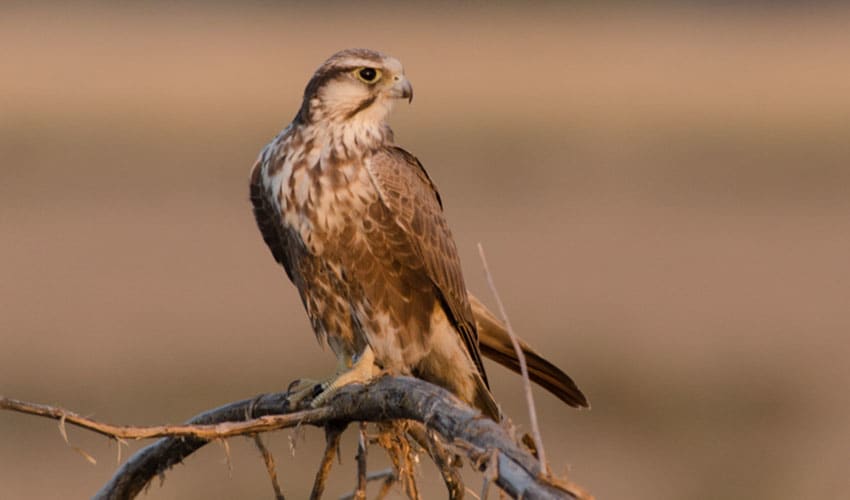
At first glance, it looks similar to other large falcons, especially the Peregrine Falcon, but it has its own unique personality and appearance. The Laggar is usually bulkier, with broader wings and a heavier build, giving it a strong, muscular look. Its coloring is more earthy and muted—shades of brown, gray, and sandy tones—helping it blend into dry landscapes like grasslands, deserts, and open plains. Unlike some falcons that thrive in cold or coastal regions, the Laggar is perfectly adapted to hot climates, often soaring under intense sun where few other falcons feel at home.
One of the most distinct characteristics of the Laggar Falcon is its hunting style. While many falcons rely on extreme speed and dramatic high dives, the Laggar prefers strength, persistence, and strategy. It often hunts closer to the ground, chasing prey in long, powerful flights rather than sudden vertical drops. This makes it especially good at catching birds like pigeons, partridges, and doves. Compared to its faster cousins, the Laggar may seem less flashy, but it is incredibly efficient. Its broad wings allow it to glide smoothly and conserve energy, which is useful in hot environments where stamina matters more than speed.
What truly sets the Laggar Falcon apart from other falcons is its independence and adaptability. It is less migratory than many related species and often stays in the same region year-round. This means it learns its territory well and becomes an expert at finding food even when conditions are tough. Laggars are also more tolerant of human-altered landscapes and are sometimes seen near farmlands, cities, and roadsides. While many falcons avoid people, the Laggar seems to quietly coexist with them, making use of open spaces and abundant prey without much conflict.
Distribution
 Afghanistan
 Bangladesh
 India
India Iran
Iran Kazakhstan
 Myanmar
 Nepal
Nepal Pakistan
 Turkmenistan
 Vietnam
Anything we've missed?
Help us improve this page by suggesting edits. Glory never dies!
Suggest an editGet to know me
Terrestrial / Aquatic
Altricial / Precocial
Polygamous / Monogamous
Dimorphic (size) / Monomorphic
Active: Diurnal / Nocturnal
Social behavior: Solitary / Pack / Herd
Diet: Carnivore / Herbivore / Omnivore / Piscivorous / Insectivore
Migratory: Yes / No
Domesticated: Yes / No
Dangerous: Yes / No


