


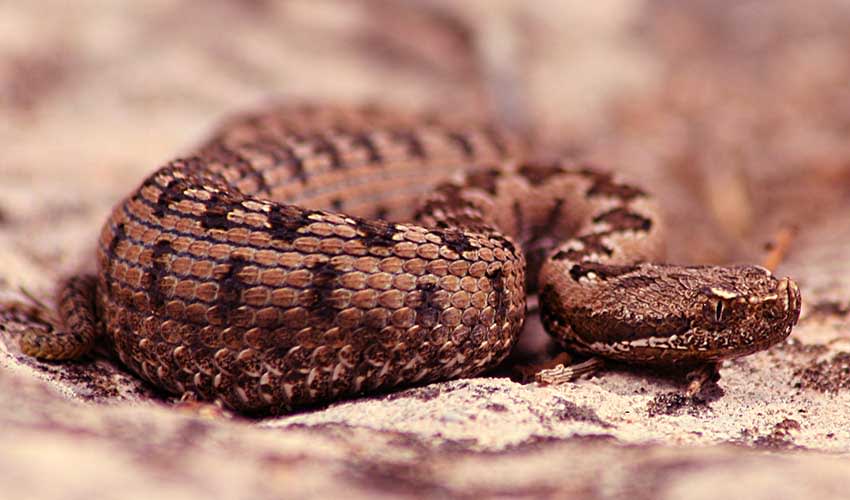
A small but striking venomous snake native to the Iberian Peninsula and parts of North Africa. Known for its distinctive upturned “snub-nose” and intricate zigzag patterns, it’s a master of camouflage and stealth—a true emblem of the Mediterranean wilderness. Despite its small size, this viper has earned a fierce reputation for both its beauty and its resilience in some of Europe’s harshest dry habitats.
Lataste’s viper grows with a thick, muscular body and a triangular head characteristic of true vipers. Its coloration varies from gray and sandy brown to olive or reddish tones, blending seamlessly into rocky and scrubby landscapes. The snake’s most recognizable feature is its slightly upturned snout, giving it a “hooked” or “snubbed” appearance. Running down its back is a bold zigzag or diamond-shaped pattern, which provides excellent camouflage against the sun-dappled stones and dry brush it hides among. Many individuals also sport a bright yellow or orange tip on their tail, which they wiggle like a lure to attract curious prey—a clever hunting trick known as caudal luring.
This viper is an ambush predator, preferring to lie in wait rather than chase. It feeds mainly on small mammals, lizards, and young birds, striking quickly with its venomous fangs and then retreating as the prey succumbs. Its venom is hemotoxic, causing pain, swelling, and tissue damage but rarely posing a lethal threat to healthy adult humans. Like most snakes, it only bites when threatened or cornered, preferring to remain hidden. During cooler months, Lataste’s viper is diurnal, basking in the sun to stay warm, while in the hot summer it becomes more nocturnal or crepuscular, active at dusk and dawn to avoid the desert heat.
Distribution
 Portugal
 Spain
SpainAnything we've missed?
Help us improve this page by suggesting edits. Glory never dies!
Suggest an editGet to know me
Terrestrial / Aquatic
Altricial / Precocial
Polygamous / Monogamous
Dimorphic (size) / Monomorphic
Active: Diurnal / Nocturnal
Social behavior: Solitary / Pack / Herd
Diet: Carnivore / Herbivore / Omnivore / Piscivorous / Insectivore
Migratory: Yes / No
Domesticated: Yes / No
Dangerous: Yes / No




