


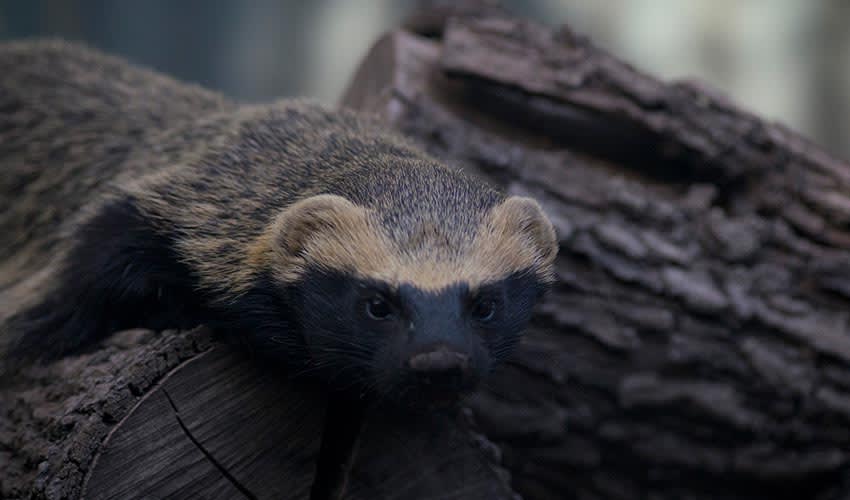
A small, tough-looking hunter from Central and South America that seems like it’s always in a hurry. It has a long, low body, short legs, and a thick neck and shoulders that give it a sturdy, bulldog-like vibe for such a small animal. Its coloring is instantly recognizable: the top half of its body is usually grayish to silvery, while the underside and legs are darker, often black or very dark brown. A bold pale stripe typically runs from the forehead over the head and down the back, like a sharp line drawn to separate “light jacket” from “dark pants.”
What makes the lesser grison stand out from many other mustelids (the weasel family) is its mix of ruggedness and flexibility. It’s not as long and threadlike as many weasels, and not as water-shaped as otters; instead, it’s a compact, ground-focused chaser that can still climb, swim, and squeeze into tight spaces when needed. It’s often described as bold, even feisty, and it has the kind of fearless reputation that makes mustelids famous. When threatened, it may hiss, growl, show its teeth, or release a strong musky smell—basically a full “back off” toolkit packed into a small body.
The lesser grison is also an adaptable resident of many landscapes. It can live in grasslands, scrub, forest edges, wetlands, farmland, and open country, as long as there’s cover and food. Unlike animals that specialize in just one habitat, it’s more of a generalist, taking advantage of whatever the local environment offers. It hunts mostly on the ground, using its nose to follow trails and its body to dive into burrows or under brush. Small mammals are a common target, but it can also take birds, eggs, reptiles, frogs, large insects, and other easy-to-catch prey.
Distribution
 Argentina
 Bolivia
 Brazil
 Chile
Chile Paraguay
 Peru
PeruAnything we've missed?
Help us improve this page by suggesting edits. Glory never dies!
Suggest an editGet to know me
Terrestrial / Aquatic
Altricial / Precocial
Polygamous / Monogamous
Dimorphic (size) / Monomorphic
Active: Diurnal / Nocturnal
Social behavior: Solitary / Pack / Herd
Diet: Carnivore / Herbivore / Omnivore / Piscivorous / Insectivore
Migratory: Yes / No
Domesticated: Yes / No
Dangerous: Yes / No




