


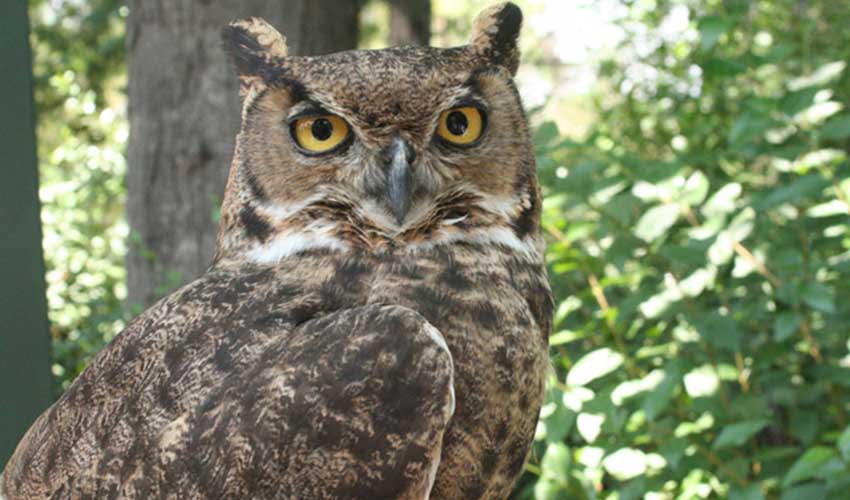
A small and often overlooked member of the horned owl family, quietly standing apart from its more famous relatives. While many people picture horned owls as large, powerful birds with dramatic ear tufts and booming calls, the lesser horned owl breaks that expectation with a more modest size and a subtler presence. Its “horns,” which are actually feather tufts, are shorter and less pronounced, giving it a softer and sometimes almost curious expression. This owl’s coloring tends to blend easily with tree bark and dry leaves, making it a master of camouflage. Because it relies more on staying hidden than on intimidation, it is often difficult to spot, even for experienced bird watchers.
Unlike larger horned owls that confidently dominate their territory, the lesser horned owl is more cautious and reserved. It prefers dense woods, quiet groves, or lightly wooded grasslands where it can remain unseen. Its call is also gentler and less booming, often described as a soft hoot or low series of notes rather than a loud declaration. This quieter voice helps it avoid drawing attention from predators and larger owls that might see it as competition. In this way, the lesser horned owl survives not by force but by cleverness and restraint.
While many horned owls rely on sheer strength to take down larger prey, the lesser horned owl focuses on speed and surprise. It mainly hunts small animals such as mice, insects, and small birds, swooping down quickly and silently from low perches. Its flight is remarkably quiet, allowing it to approach prey without being detected. Fun fact: this owl can rotate its head extremely far, which helps it scan its surroundings without moving its body and giving away its position.
Distribution
 Argentina
 Bolivia
 Chile
Chile Falkland Islands
 Peru
PeruAnything we've missed?
Help us improve this page by suggesting edits. Glory never dies!
Suggest an editGet to know me
Terrestrial / Aquatic
Altricial / Precocial
Polygamous / Monogamous
Dimorphic (size) / Monomorphic
Active: Diurnal / Nocturnal
Social behavior: Solitary / Pack / Herd
Diet: Carnivore / Herbivore / Omnivore / Piscivorous / Insectivore
Migratory: Yes / No
Domesticated: Yes / No
Dangerous: Yes / No




