


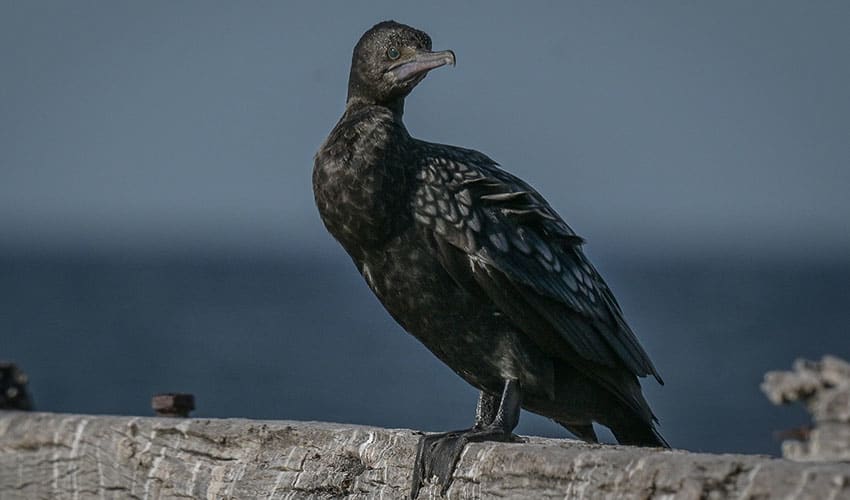
As its name suggests, it is smaller than many other cormorants, but what it lacks in size it makes up for in agility and adaptability. With its slender body, long neck, and narrow bill, the little black cormorant has a graceful appearance that suits its active lifestyle. Its plumage is almost entirely black, sometimes showing a glossy green or purple sheen in bright light.
One of the most distinctive traits of the little black cormorant is its strong preference for freshwater environments. While it can be found in coastal areas, it is most commonly seen on inland lakes, rivers, wetlands, and reservoirs. It often gathers in large flocks, both when feeding and when resting. These flocks can include dozens or even hundreds of birds, creating an impressive sight when they take off together or line up along tree branches and sandbanks.
The little black cormorant is an expert diver and a highly efficient hunter. It feeds mainly on fish, which it catches by diving beneath the surface and swimming underwater with powerful strokes of its webbed feet. Unlike some larger cormorants that rely solely on strength, this species is quick and agile, enabling it to chase fast-moving prey. It often feeds in groups, herding fish into shallower water where they are easier to catch. This cooperative hunting behavior is one of the reasons the species is so successful.
Like all cormorants, the little black cormorant has feathers that are not fully waterproof. This helps reduce buoyancy and makes diving easier, but it also means the bird must dry its feathers after feeding. As a result, it is frequently seen perched with its wings spread wide, facing the sun or wind. This familiar pose is a classic image of cormorants and is especially striking when many birds do it at once in large roosting groups.
Distribution
 Australia
 Christmas Island
 East Timor
 Indonesia
 New Caledonia
 New Zealand
 Palau
Palau Papua New Guinea
Anything we've missed?
Help us improve this page by suggesting edits. Glory never dies!
Suggest an editGet to know me
Terrestrial / Aquatic
Altricial / Precocial
Polygamous / Monogamous
Dimorphic (size) / Monomorphic
Active: Diurnal / Nocturnal
Social behavior: Solitary / Pack / Flock
Diet: Carnivore / Herbivore / Omnivore / Piscivorous / Insectivore
Migratory: Yes / No
Domesticated: Yes / No
Dangerous: Yes / No




