


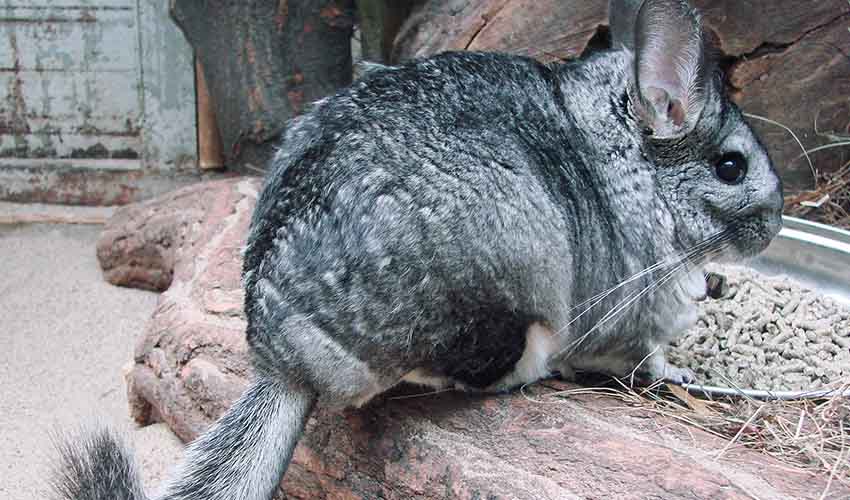
One of the most extraordinary mammals of the Andes, it is famous worldwide for having the softest fur of any land animal. Native to the rocky, wind-swept slopes of Chile’s coastal and Andean mountains, this small rodent has a delicate appearance, with large, round ears, long whiskers, and expressive black eyes. Its body is sleek and compact, covered in a gorgeous coat of dense gray fur, while its tail—longer and more feathery than that of its short-tailed cousin—helps it balance as it leaps between steep rocks. Although many people today recognize chinchillas as adorable pets, wild long-tailed chinchillas remain incredibly rare and very different from their domesticated relatives.
Life in the Andes has shaped the long-tailed chinchilla into an exceptional survivor. The species lives at high elevations where temperatures plunge at night and water is scarce. Its fur, made of dozens of hairs packed into each follicle, acts as a natural insulating layer against the freezing cold. Its long tail serves as a stabilizer when jumping, allowing the chinchilla to navigate rocky cliffs with agility similar to that of a small mountain goat. With strong hind legs and a flexible spine, it can leap impressively far for its size, using cracks and crevices as safe retreats from predators like owls, foxes, and wild cats.
The long-tailed chinchilla is primarily a nocturnal or crepuscular animal, becoming active in the dim light of dawn, dusk, and nighttime. It feeds on hardy mountain vegetation such as grasses, leaves, seeds, and bark—plants that thrive in dry, rocky conditions. Because its environment offers very little water, the chinchilla relies on moisture from food and has adapted to conserve every drop. Like all chinchillas, it cannot get wet easily; its thick fur traps moisture and can lead to health problems. Instead, it stays clean by taking dust baths, rolling joyfully in fine volcanic ash that absorbs oils and keeps the coat fluffy and healthy. This behavior is one of the chinchilla’s most charming traits and an essential part of its survival.
Distribution
 Chile
ChileAnything we've missed?
Help us improve this page by suggesting edits. Glory never dies!
Suggest an editGet to know me
Terrestrial / Aquatic
Altricial / Precocial
Polygamous / Monogamous
Dimorphic (size) / Monomorphic
Active: Diurnal / Nocturnal
Social behavior: Solitary / Pack / Herd
Diet: Carnivore / Herbivore / Omnivore / Piscivorous / Insectivore
Migratory: Yes / No
Domesticated: Yes / No
Dangerous: Yes / No




