


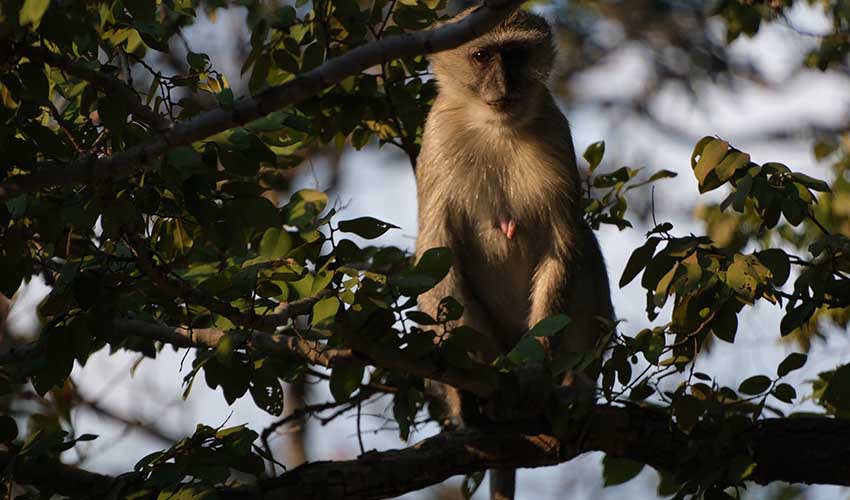
Closely related to vervet monkeys and green monkeys, the Malbrouck is known for its alert expression, agile movements, and adaptable nature. It inhabits a wide variety of environments—from savannas and dry woodlands to riverbanks, forest edges, and even areas near human settlements. Among the most widespread primates of its region, the Malbrouck plays an important role in its ecosystems and is well known for its curiosity and social behavior.
In terms of appearance, the Malbrouck is a medium-sized monkey with a slim, athletic build. Its fur is generally grayish or olive-brown, with lighter underparts. The face is mostly dark, framed by white or pale fur that gives the monkey a bright, expressive look. Like other members of the Chlorocebus genus, the Malbrouck has distinctive facial features, including a blackish muzzle and striking pale eyebrows that make its expressions easy to read. Its long tail—longer than its body—is used for balance as it runs, climbs, and leaps through trees and open grassland.
Males are larger than females, and sexual dimorphism is visible in size and in the bright coloration of certain body parts, typical of vervet relatives.
The Malbrouck is an omnivore with a flexible diet, which contributes to its success across diverse habitats. It feeds on fruits, seeds, flowers, leaves, insects, small vertebrates, and even bird eggs when the opportunity arises. This broad diet allows it to take advantage of seasonal food shifts and live comfortably in areas where resources change dramatically throughout the year. In many regions, Malbroucks also feed on cultivated crops, leading to occasional conflict with farmers—but also demonstrating their remarkable adaptability.
Malbroucks are active, alert, and fast-moving. They are both arboreal and terrestrial, moving easily between trees and ground depending on food availability and the presence of predators. Their agility helps them evade threats such as eagles, leopards, servals, and large snakes. When alarmed, Malbroucks may give sharp calls or retreat into trees for safety.
Distribution
 Angola
 Congo-Brazzaville
 DR Congo (Kinshasa)
 Namibia
 Zambia
Anything we've missed?
Help us improve this page by suggesting edits. Glory never dies!
Suggest an editGet to know me
Terrestrial / Aquatic
Altricial / Precocial
Polygamous / Monogamous
Dimorphic (size) / Monomorphic
Active: Diurnal / Nocturnal
Social behavior: Solitary / Pack / Troop
Diet: Carnivore / Herbivore / Omnivore / Piscivorous / Insectivore
Migratory: Yes / No
Domesticated: Yes / No
Dangerous: Yes / No




