


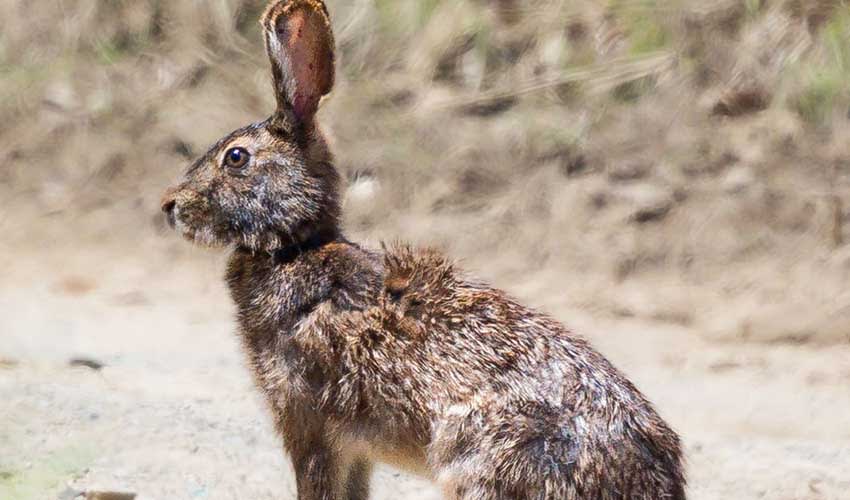
A quick, forest-loving hare built for weaving through thickets rather than showing off in wide-open fields. It has the classic hare shape—long hind legs, a slim body, and alert ears—but its overall look often feels more “woodland” than “prairie.” Its coat is usually dark brown to gray-brown, with a slightly rough, speckled texture that blends into leaf litter, fallen branches, and shadowy undergrowth. Up close, the fur can look like a mix of tiny flecks, which helps it disappear when it freezes. The ears are long and sensitive, but often not as dramatically oversized as those of some open-country hares, and the tail is short, with darker tones that don’t wave like a bright flag when it runs.
While some hares are famous for living in open grasslands or steppe where speed and long sightlines matter most, this one is often associated with woodland, brushy hills, and mixed habitats where turning fast and staying hidden can matter just as much as sprinting. Its darker coloring fits that life: instead of standing out against tree shade, it melts into it. Compared with hares that change into a near-white winter coat in far northern regions, the Manchurian hare generally keeps a more earthy palette, sometimes shifting in tone with the seasons but staying “forest-colored” rather than turning into a bright snow animal everywhere it lives.
Day to day, the Manchurian hare runs on a simple routine: feed, listen, and stay ready to launch. It’s often most active around dusk and dawn, when the light is low, and it can move with less risk. Its diet is mostly plants—grasses and green growth when available, plus leaves, shoots, and tender stems. In colder months, when fresh plants are scarce, it may turn to twigs and bark, which is a tough menu but a reliable one.
Distribution
 China
China North Korea
 Russia
Anything we've missed?
Help us improve this page by suggesting edits. Glory never dies!
Suggest an editGet to know me
Terrestrial / Aquatic
Altricial / Precocial
Polygamous / Monogamous
Dimorphic (size) / Monomorphic
Active: Diurnal / Nocturnal
Social behavior: Solitary / Pack / Herd
Diet: Carnivore / Herbivore / Omnivore / Piscivorous / Insectivore
Migratory: Yes / No
Domesticated: Yes / No
Dangerous: Yes / No




