


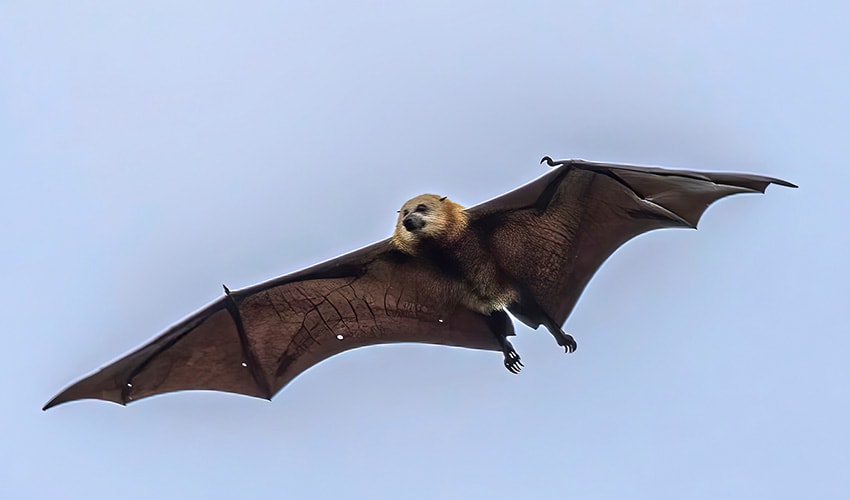
A big, fox-faced fruit bat found only on the Mascarene Islands, mainly Mauritius. It’s the island’s largest native land mammal, with a wingspan of about 80 cm and a body cloaked in thick golden-brown fur and darker brown “cape” across the shoulders and back. Up close, it really does look like a little fox: long snout, bright eyes, and small ears set into a fluffy “collar” of fur. When roosting in trees during the day, they hang in clusters, wrapped in their own dark wings like umbrellas, turning big trees in places like Black River Gorges and Bel Ombre into living bat chandeliers.
At night, the Mauritian flying fox becomes one of the island’s most important forest gardeners. It feeds on dozens of plant species—mainly fruit and nectar—and usually squeezes fruit in its mouth to suck out the juice before spitting out most of the pulp and seeds. Seeds get dropped or carried away and released in flight with the bat’s droppings, which helps native trees colonize new spots and reconnect tiny fragments of forest in a country where less than 2% of native vegetation remains. Tracking studies with GPS tags show that individuals can travel many kilometers in a single night, linking coastal areas, valleys, and upland forests as they commute between feeding sites and roosts. That long-distance seed delivery makes this species disproportionately important for the survival and recovery of Mauritian forests compared with its modest numbers.
Unfortunately, the Mauritian flying fox is also at the center of a heated conservation conflict. Fruit growers blame the bats for damage to lychee, mango, and other commercial crops, and the government has repeatedly authorized large culls since 2015, killing tens of thousands of bats.
Distribution
 Mauritius
 Réunion
Anything we've missed?
Help us improve this page by suggesting edits. Glory never dies!
Suggest an editGet to know me
Terrestrial / Aquatic
Altricial / Precocial
Polygamous / Monogamous
Dimorphic (size) / Monomorphic
Active: Diurnal / Nocturnal
Social behavior: Solitary / Pack / Herd
Diet: Carnivore / Frugivore / Omnivore / Piscivorous / Insectivore
Migratory: Yes / No
Domesticated: Yes / No
Dangerous: Yes / No




