


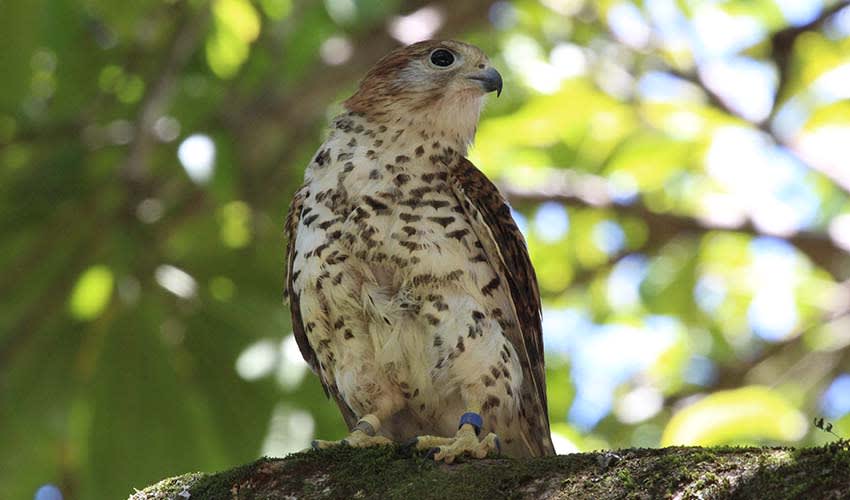
A small falcon found naturally only on the island of Mauritius, and it has one of the most dramatic comeback stories of any bird. It looks like a compact, sharp-eyed hunter: warm brown on the head and back, pale underparts sprinkled with dark spots, and a longish tail with clear banding. Unlike many raptors that spend their time soaring high, this kestrel often works the landscape at lower heights, using quick bursts of speed and tight turns. A neat quirk is that males and females look very similar in color, so you can’t reliably tell them apart at a glance the way you can with some other kestrels.
Its home is mainly the remaining native forest, cliffs, and deep ravines of southwest Mauritius, places where thick cover and steep terrain give it good nesting sites and plenty of hunting opportunities. It feeds on whatever is catchable and common in its island habitat—especially geckos and large insects, and it can also take small birds. It hunts with a mix of patience and sudden action: watching from a perch, then launching in a fast dash to grab prey, or slipping through trees with surprising agility. This “forest falcon” style is part of what makes it feel different from the open-country kestrels people may know from fields and roadsides.
The Mauritius kestrel is famous for nearly disappearing. In the 1970s, it dropped to a tiny number of birds in the wild, often described as the rarest bird in the world at the time. A combination of habitat loss, pesticides, and introduced predators pushed it to the edge. What saved it was a determined conservation effort that included careful monitoring, captive breeding, and the release of young birds back into the wild. People sometimes talk about this species as a symbol of hope because it shows what can happen when conservation is sustained for decades, not just for a season.
Distribution
 Mauritius
 Official estimate
Anything we've missed?
Help us improve this page by suggesting edits. Glory never dies!
Suggest an editGet to know me
Terrestrial / Aquatic
Altricial / Precocial
Polygamous / Monogamous
Dimorphic (size) / Monomorphic
Active: Diurnal / Nocturnal
Social behavior: Solitary / Pack / Herd
Diet: Carnivore / Herbivore / Omnivore / Piscivorous / Insectivore
Migratory: Yes / No
Domesticated: Yes / No
Dangerous: Yes / No




