


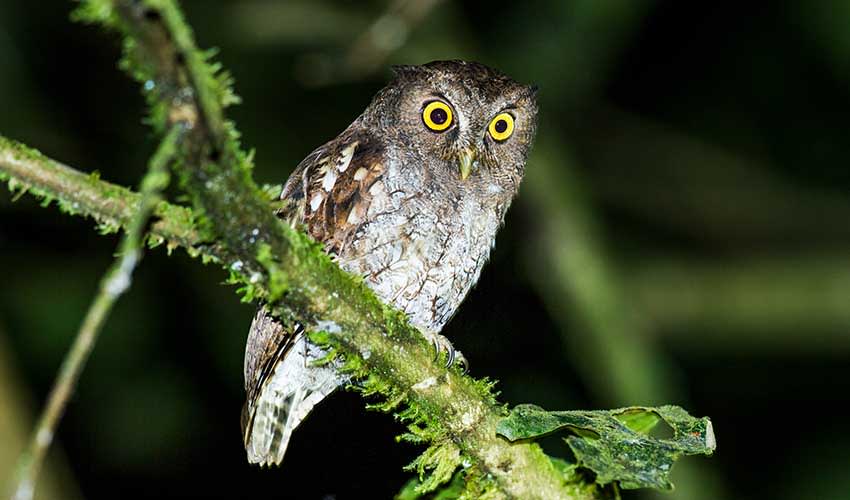
Despite its name, it does not actually screech very often. Instead, it produces a series of soft trills, whistles, and gentle hoots that blend easily into the sounds of the night. This owl is compact and sturdy, with a rounded body, a short tail, and small ear tufts that give it a slightly alert, expressive look. Its feathers are usually gray or brown with fine patterns, helping it blend perfectly with tree bark and branches.
Unlike many owls that depend only on deep forests, this species can live in a wide range of environments. It is commonly found in woodlands, forest edges, plantations, and even near towns and villages where trees are present. During the day, it rests quietly in tree holes or dense foliage, relying on camouflage to stay hidden. Many people pass right by one without ever realizing an owl is watching from nearby.
What sets this owl apart from other screech-owls is its behavior and vocal style. Its calls are more musical and less harsh than those of some related species, often sounding like bouncing notes or soft trembles. These calls are used to communicate with mates and mark territory rather than to scare intruders. The Middle American Screech-Owl is also less aggressive than larger owls, choosing stealth and caution instead of confrontation. When threatened, it may stretch its body tall and narrow, trying to resemble a broken branch rather than flying away.
The hunting style of this owl is another key feature. A night hunter relies on excellent hearing and keen eyesight to locate prey in low light. Its diet is varied and flexible, including insects, small rodents, lizards, frogs, and even small birds. This wide diet helps it survive in different habitats and seasons. It usually hunts from a perch, dropping silently onto prey below.
Distribution
 Belize
 Guatemala
 Honduras
 Mexico
 Nicaragua
Anything we've missed?
Help us improve this page by suggesting edits. Glory never dies!
Suggest an editGet to know me
Terrestrial / Aquatic
Altricial / Precocial
Polygamous / Monogamous
Dimorphic (size) / Monomorphic
Active: Diurnal / Nocturnal
Social behavior: Solitary / Pack / Herd
Diet: Carnivore / Herbivore / Omnivore / Piscivorous / Insectivore
Migratory: Yes / No
Domesticated: Yes / No
Dangerous: Yes / No




