


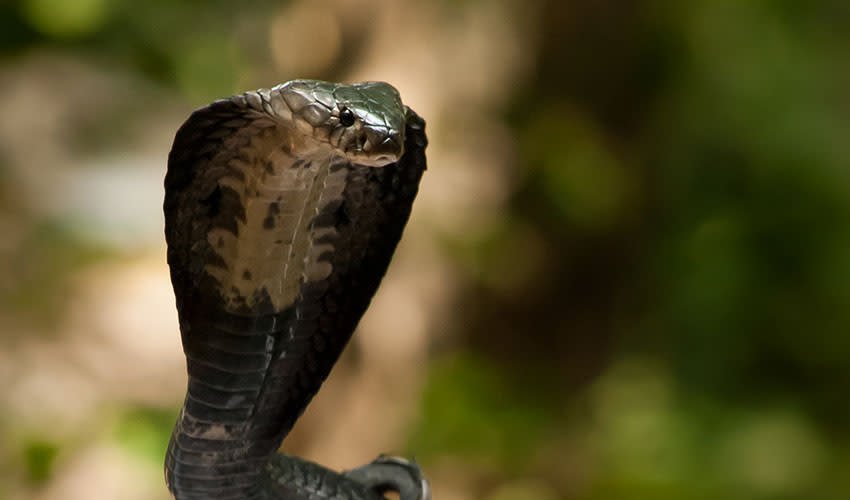
One of Asia’s most iconic and mesmerizing snakes—a creature that commands both fear and fascination. Named for the distinctive circular “monocle” marking on the back of its hood, this cobra is found across South and Southeast Asia, from India and Bangladesh to Thailand, Cambodia, and Vietnam.
This species is medium to large-sized, usually growing between 1.2 and 1.8 meters (4 to 6 feet) in length, though some individuals can exceed 2 meters. Its coloration varies widely depending on its region—from pale yellow and golden brown to dark olive or jet black. The most recognizable feature, of course, is the single circular or oval marking on the back of its hood, which resembles an eye or monocle and gives the species its name. When threatened, the cobra raises the front portion of its body and spreads its hood wide, displaying this striking pattern as a warning—an unmistakable gesture of defense and dominance.
The monocled cobra inhabits a wide range of environments, from rice paddies and grasslands to forests and even urban areas. It is both terrestrial and semi-aquatic, often found near water sources where it hunts frogs, toads, lizards, birds, and small mammals. This species is a formidable predator, relying on both speed and precision to strike. It is equipped with potent neurotoxic venom, capable of paralyzing its prey within moments by disrupting nerve signals. In humans, a bite can be extremely dangerous if untreated, making the monocled cobra one of Asia’s most medically significant snakes. However, like most snakes, it prefers to avoid confrontation and will only strike when provoked or cornered.
In addition to its fearsome reputation, the monocled cobra holds an important place in local culture and mythology. In many parts of Asia, cobras are symbols of wisdom, protection, and transformation. They often appear in folklore, temple carvings, and traditional snake charming performances—though such practices are declining today due to wildlife protection efforts.
Distribution
 Bangladesh
 Bhutan
 Cambodia
 China
China India
India Laos
Laos Malaysia
 Myanmar
 Nepal
Nepal Thailand
 Vietnam
Anything we've missed?
Help us improve this page by suggesting edits. Glory never dies!
Suggest an editGet to know me
Terrestrial / Aquatic
Altricial / Precocial
Polygamous / Monogamous
Dimorphic (size) / Monomorphic
Active: Diurnal / Nocturnal
Social behavior: Solitary / Pack / Herd
Diet: Carnivore / Herbivore / Omnivore / Piscivorous / Insectivore
Migratory: Yes / No
Domesticated: Yes / No
Dangerous: Yes / No




