


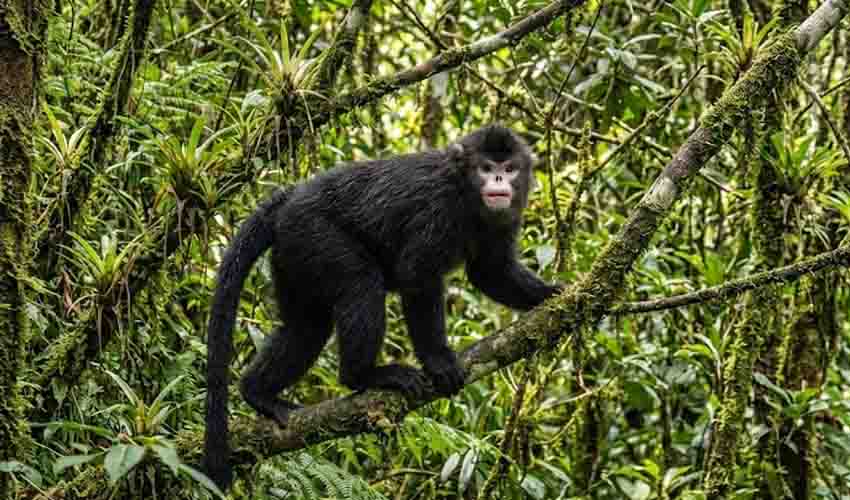
Discovered only in the early 21st century, this monkey quickly captured global attention due to its unique appearance and rarity. Its thick fur is mostly black, with white patches on the ears, chin, and chest, giving it a bold contrast that stands out in its forest habitat. The flat, forward-facing nostrils give the species its “snub-nosed” name and contribute to a look that seems almost humanlike in expression.
This monkey is found only in a small region of northern Myanmar, where it lives in high-altitude forests near the border with China. Its habitat includes cold, mountainous areas with dense forest cover, which is unusual for many primates. The thick fur of the Myanmar snub-nosed monkey helps it survive chilly temperatures, fog, and seasonal snowfall. These monkeys spend most of their lives in the trees, moving carefully through branches and rarely coming down to the ground. Because they live in such remote and rugged terrain, they remained unknown to science for a long time.
Social life is an important part of this species’ behavior. Myanmar snub-nosed monkeys live in groups that may include dozens of individuals, often organized into smaller family units within a larger group. These groups travel together through the forest, feeding, resting, and grooming as a community. Grooming helps strengthen social bonds and reduce stress, while vocal calls and body language are used to communicate within the group.
The diet of the Myanmar snub-nosed monkey is mostly plant-based. It feeds on leaves, buds, fruits, seeds, and bark, depending on the season. During colder months, when fruit is scarce, leaves and other tough plant parts become especially important. Its digestive system is well adapted for handling fibrous plant material, allowing it to survive in environments where food can be limited for long periods.
Distribution
 China
China Myanmar
Anything we've missed?
Help us improve this page by suggesting edits. Glory never dies!
Suggest an editGet to know me
Terrestrial / Aquatic
Altricial / Precocial
Polygamous / Monogamous
Dimorphic (size) / Monomorphic
Active: Diurnal / Nocturnal
Social behavior: Solitary / Pack / Troop
Diet: Carnivore / Herbivore / Omnivore / Piscivorous / Insectivore
Migratory: Yes / No
Domesticated: Yes / No
Dangerous: Yes / No




