


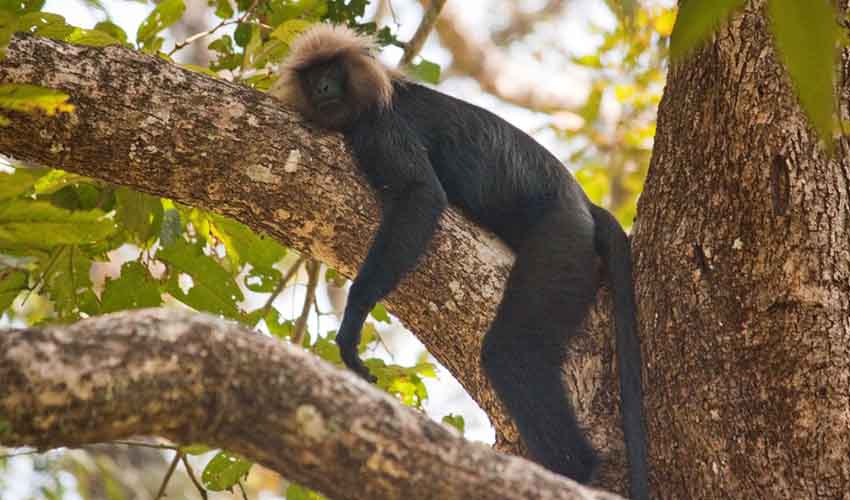
A beautiful, almost dramatic-looking monkey that seems dressed for a festival every day. Its body is covered in glossy black fur, while its head and neck are wrapped in a shaggy mane of golden to copper-orange hair, like a hood or halo. This sharp contrast between dark body and bright “hood” makes it stand out even in the dim light of a forest. The face is dark and hairless, with deep, watchful eyes and a curious, slightly serious expression. Its tail is long and black, often held in a gentle curve as it moves through the trees.
These monkeys live only in the southern Western Ghats of India, mainly in the hill and mountain forests of Kerala, Tamil Nadu and parts of Karnataka. They are most common in evergreen and semi-evergreen forests, shola–grassland mosaics and older plantations with tall shade trees. Nilgiri langurs are active during the day and spend most of their time in the trees, though they will sometimes come to the ground to move between patches of forest or to feed.
Their diet is dominated by leaves, especially young, tender ones, but they also eat fruits, flowers, buds and bark. Because leaves are tough to digest, they have a large, multi-chambered stomach full of helpful microbes, a bit like a cow’s. This makes them look pot-bellied even when they are healthy and lean. They’ve also been seen eating soil from special spots on the ground, which may help them deal with plant toxins or balance the acids in their stomach. Feeding can be a slow, careful process: a langur may spend half a minute just handling and chewing a single leaf, turning it into fuel for its energetic, arboreal life.
Distribution
 India
India Official estimate
Anything we've missed?
Help us improve this page by suggesting edits. Glory never dies!
Suggest an editGet to know me
Terrestrial / Aquatic
Altricial / Precocial
Polygamous / Monogamous
Dimorphic (size) / Monomorphic
Active: Diurnal / Nocturnal
Social behavior: Solitary / Pack / Troop
Diet: Carnivore / Herbivore / Omnivore / Piscivorous / Insectivore
Migratory: Yes / No
Domesticated: Yes / No
Dangerous: Yes / No




