


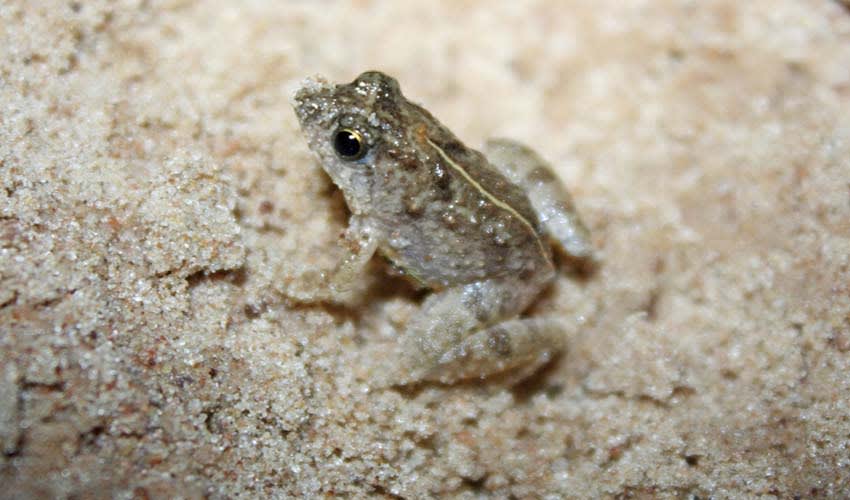
A tiny but tough amphibian that lives across much of sub-Saharan Africa, from grasslands and woodlands to farms and city edges. Belonging to the puddle frog family, it is one of the most common and adaptable frog species on the continent. Its body is usually brown, olive, or gray with darker spots or stripes, perfectly camouflaged against soil, grass, or leaf litter. Despite its modest looks, this little frog is full of quirks and is a vital part of the ecosystems it inhabits.
While some frogs depend on permanent wetlands or pristine forests, this species makes do with almost any body of water—temporary rain puddles, roadside ditches, cattle troughs, or even urban gardens. During the rainy season, males gather around these makeshift pools and let out their loud, raspy “quack-like” calls, which carry surprisingly far for such a tiny creature. Their ability to take advantage of temporary puddles means they can breed successfully in places where many other frog species would never survive.
Their reproductive strategy is all about speed. Females lay hundreds of eggs in shallow puddles, which hatch into tadpoles that develop quickly before the water dries up. This rapid life cycle ensures that even the smallest and most short-lived water source can support the next generation. While their short legs make them poor jumpers compared to other frogs, they are excellent crawlers and hoppers, darting quickly into cover when danger approaches. Their diet consists mainly of ants, termites, and other tiny insects, making them important natural pest controllers.
Distribution
 Angola
 Benin
Benin Botswana
 Burkina Faso
 Burundi
 Cameroon
 Central Af. Rep.
 Chad
Chad Congo-Brazzaville
 Côte D’ivoire
 DR Congo (Kinshasa)
 Eritrea
 Eswatini
 Ethiopia
 Gambia
 Ghana
Ghana Guinea-Bissau
 Guinea
 Kenya
Kenya Lesotho
 Liberia
 Malawi
 Mali
Mali Mauritania
 Mozambique
 Namibia
 Nigeria
 Rwanda
 Senegal
 Sierra Leone
 South Africa
 South Sudan
 Sudan
Sudan Tanzania
 Togo
Togo Uganda
 Zambia
 Zimbabwe
Anything we've missed?
Help us improve this page by suggesting edits. Glory never dies!
Suggest an editGet to know me
Terrestrial / Aquatic
Altricial / Precocial
Polygamous / Monogamous
Dimorphic (size) / Monomorphic
Active: Diurnal / Nocturnal
Social behavior: Solitary / Pack / Herd
Diet: Carnivore / Herbivore / Omnivore / Piscivorous / Insectivore
Migratory: Yes / No
Domesticated: Yes / No
Dangerous: Yes / No




