


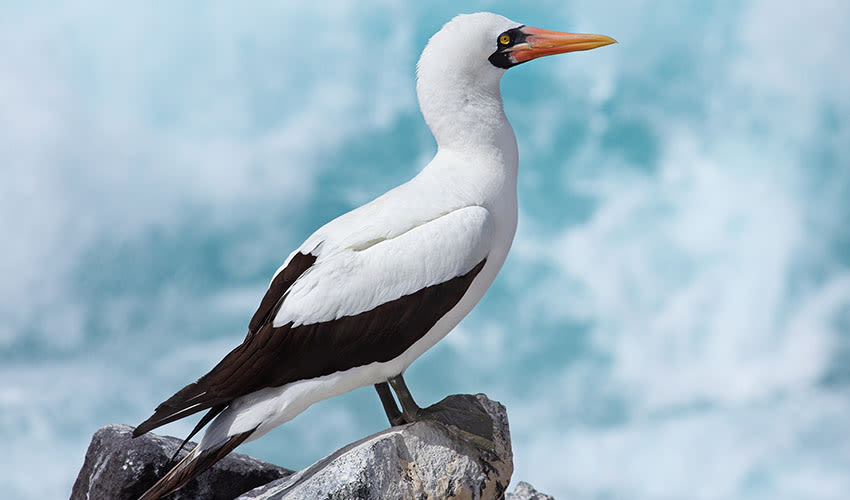
Tall, elegant, and powerful, this booby is built for life over open water. It has long wings, a streamlined body, and a sharp, pointed bill that make it an efficient hunter and a confident flier. With its mostly white plumage contrasted by dark wings and tail, the Nazca booby stands out clearly against blue skies and rocky nesting grounds.
One of the most distinctive features of the Nazca booby is its face. Adults have a pale yellow to orange bill and dark skin around the eyes, giving them a bold, intense expression. Males and females look similar, though females are generally slightly larger. Juveniles appear quite different, with darker brownish plumage that slowly lightens as they mature. It can take several years for young Nazca boobies to develop the clean white appearance of adults.
The Nazca booby is an expert hunter that relies on plunge-diving to catch prey. Flying high above the ocean, it scans the surface for fish and squid. Once prey is spotted, the bird folds its wings and dives headfirst into the water at high speed. Its streamlined body and strong neck help it withstand the impact, allowing it to chase prey underwater for short distances. This hunting style is both dramatic and effective, making the Nazca booby one of the most impressive seabirds to watch while feeding.
The Nazca booby is closely tied to ocean conditions. Changes in water temperature and fish availability can strongly affect breeding success. Because it depends on healthy marine ecosystems, the species is often seen as an indicator of ocean health. While many populations remain stable, their reliance on specific nesting islands and food sources makes them sensitive to environmental change.
Distribution
 Colombia
 Ecuador
 El Salvador
 French Polynesia
 Guatemala
 Mexico
 Peru
PeruAnything we've missed?
Help us improve this page by suggesting edits. Glory never dies!
Suggest an editGet to know me
Terrestrial / Aquatic
Altricial / Precocial
Polygamous / Monogamous
Dimorphic (size) / Monomorphic
Active: Diurnal / Nocturnal
Social behavior: Solitary / Pack / Flock
Diet: Carnivore / Herbivore / Omnivore / Piscivorous / Insectivore
Migratory: Yes / No
Domesticated: Yes / No
Dangerous: Yes / No




