


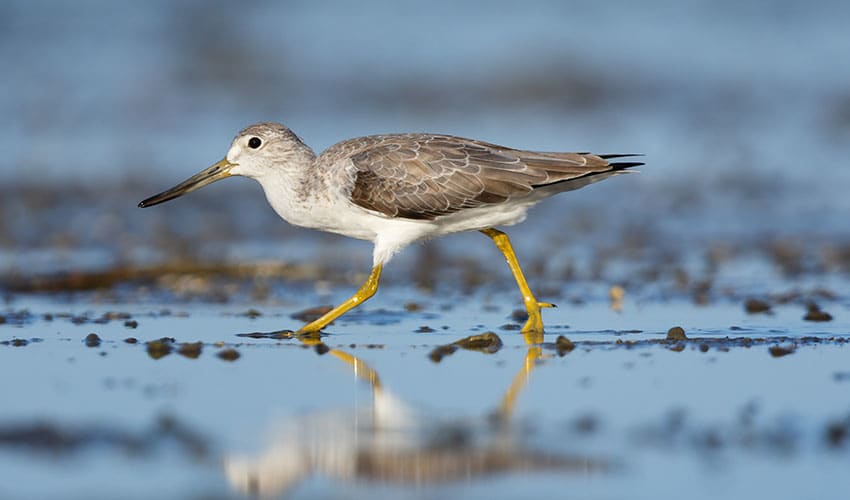
Birders often describe it as the “rugby player” compared with the slimmer, more elegant look of the common greenshank. It has a thicker, slightly heavier bill, often showing a clear two-tone effect, and shorter-looking legs that make its body seem closer to the ground. In the breeding season, it can appear especially striking, with bold dark markings that give it a more strongly patterned look than you might expect from a greenshank-type bird. Even when it’s standing still, the overall impression is of a solid, muscular shorebird built for working shallow water rather than striding through it.
What most clearly distinguishes Nordmann’s greenshank from similar species—especially the common greenshank—is the combination of stockier shape, shorter legs, and heavier bill, all appearing together. Common greenshank often looks longer-legged and finer-billed, with a more “leggy” stance. Nordmann’s tends to look more compact, with the legs not projecting as much and the bill looking more purposeful, almost tool-like. In non-breeding plumage, it can also appear comparatively plainer in body patterning, which makes its structural differences (shape and proportions) even more important than feather details. If you’re scanning a mixed shorebird flock, a good clue is that Nordmann’s often looks like it’s wearing the same general outfit as other waders—but in a shorter, thicker, more solid frame.
Nordmann’s greenshank is tied to coastal wetlands along the East Asian–Australasian migration route: it breeds far to the north in Russia’s coastal areas and then travels south to spend the non-breeding season in parts of Southeast and South Asia. It relies heavily on tidal flats, estuaries, and sheltered muddy shores—places that may look empty at first, but are packed with food just under the surface. When feeding, it can be intensely focused, wading and probing with quick, efficient movements as it searches for small creatures in shallow water.
Distribution
 Bangladesh
 Brunei
 Cambodia
 China
China Hong Kong
 India
India Indonesia
 Japan
Japan Korea
Korea Malaysia
 Myanmar
 North Korea
 Philippines
 Russia
 Singapore
 Sri Lanka
 Taiwan
 Thailand
 Vietnam
Anything we've missed?
Help us improve this page by suggesting edits. Glory never dies!
Suggest an editGet to know me
Terrestrial / Aquatic
Altricial / Precocial
Polygamous / Monogamous
Dimorphic (size) / Monomorphic
Active: Diurnal / Nocturnal
Social behavior: Solitary / Pack / Flock
Diet: Carnivore / Herbivore / Omnivore / Piscivorous / Insectivore
Migratory: Yes / No
Domesticated: Yes / No
Dangerous: Yes / No




