


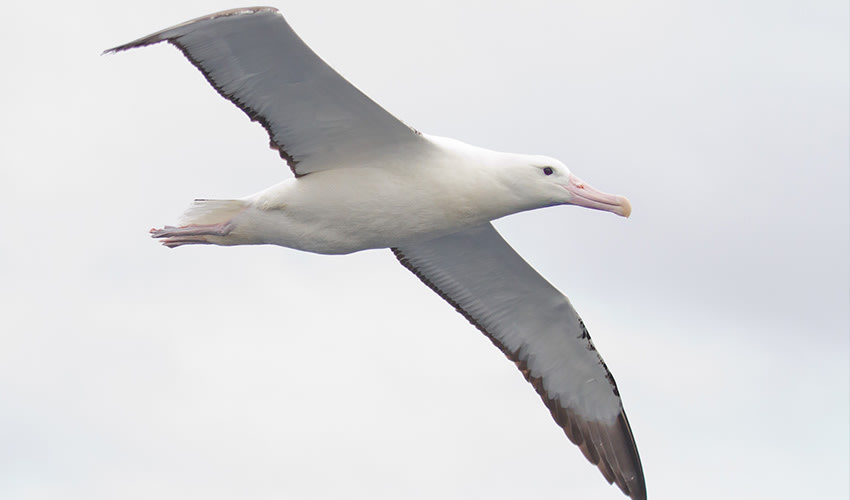
One of the largest flying birds in the world and one of the most impressive ocean travelers you could ever imagine. With its enormous wingspan, broad white body, and contrasting dark upper wings, it looks calm and commanding as it glides over the sea. In flight, it barely seems to work at all, letting the wind do most of the job while it soars for hours without flapping. On land, however, it can appear almost awkward, waddling slowly and stretching its huge wings, a reminder that this bird truly belongs to the air and the open ocean rather than solid ground.
While it can travel thousands of kilometers across the South Pacific and Southern Ocean, it breeds naturally in only a few places. One of its most famous breeding sites is at Taiaroa Head in New Zealand, the only mainland breeding colony of royal albatrosses in the world. Most other albatross species nest on remote islands far from people, but this bird has adapted to raising chicks surprisingly close to human activity. Even so, it remains loyal to specific nesting areas, returning to the same general spot year after year with remarkable accuracy.
The northern royal albatross lives a slow, deliberate life. It does not rush into adulthood, taking many years to mature before it is ready to breed. When it does, it forms strong pair bonds, often staying with the same partner for many seasons. Courtship can involve gentle displays such as bill clacking, head movements, and synchronized gestures that look almost ceremonial.
At sea, the northern royal albatross feeds mainly on squid, fish, and other ocean life found near the surface. It is perfectly adapted for long-distance travel, using wind patterns and wave-shaped air currents to move efficiently across huge areas. Its wings are not just long, but expertly shaped for gliding, turning the open ocean into a vast aerial highway.
Distribution
 Antarctica
 Argentina
 Australia
 Bouvet Island
 Brazil
 Chile
Chile Falkland Islands
 French Southern T.
Heard & McDonald
French Southern T.
Heard & McDonald New Zealand
 Saint Helena
 South Africa
 South Georgia
 Uruguay
Anything we've missed?
Help us improve this page by suggesting edits. Glory never dies!
Suggest an editGet to know me
Terrestrial / Aquatic
Altricial / Precocial
Polygamous / Monogamous
Dimorphic (size) / Monomorphic
Active: Diurnal / Nocturnal
Social behavior: Solitary / Pack / Colony
Diet: Carnivore / Herbivore / Omnivore / Piscivorous / Insectivore
Migratory: Yes / No
Domesticated: Yes / No
Dangerous: Yes / No




