


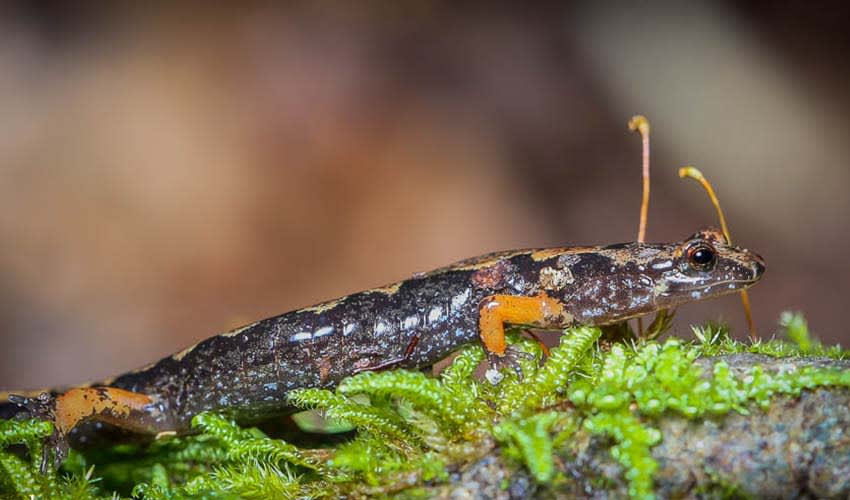
A tiny jewel of the southern Appalachian forests — a woodland sprite that thrives in cool, misty mountain streams and moss-draped slopes. Named after Tennessee’s Ocoee region, this petite amphibian carries a surprising amount of charm. Its coloration is wonderfully variable: individuals may sport rusty reds, earthy browns, warm oranges, or sleek charcoal, often with a wavy or spotted stripe running along the back. A pale belly and dark sides give it a shadow-hugging look, helping it disappear against wet leaves and streambanks.
This salamander is a master of subtle living. Found in North Carolina, Tennessee, Georgia, and South Carolina, it favors cold, clear mountain streams and the damp forests around them. It hides under rocks, logs, and leaf litter, emerging most actively on rainy days or on misty evenings. Like many dusky salamanders, it has a strong preference for clean, oxygen-rich water — a tiny sentinel for healthy mountain ecosystems. Rather than boasting flashy displays or dramatic calls, the Ocoee Salamander excels in stillness, patience, and sneaky bug-snacking. Small in size but mighty in appetite, it feeds on springtails, spiders, beetles, and other miniature forest critters.
Breeding season arrives with the warmth of spring and early summer. Females lay their tiny pearl-like eggs in moist, hidden spots near water, often guarding the clutch until hatching — an adorable display of amphibian dedication. Young salamanders begin life as aquatic larvae, sporting gills and living in quiet pools before transforming into miniature adults and moving onto land. Throughout their lives, they rely on cool, humid environments, making them sensitive to environmental change — think of them as living moisture meters for Appalachian forests.
Distribution
 United States
Anything we've missed?
Help us improve this page by suggesting edits. Glory never dies!
Suggest an editGet to know me
Terrestrial / Aquatic
Altricial / Precocial
Polygamous / Monogamous
Dimorphic (size) / Monomorphic
Active: Diurnal / Nocturnal
Social behavior: Solitary / Pack / Herd
Diet: Carnivore / Herbivore / Omnivore / Piscivorous / Insectivore
Migratory: Yes / No
Domesticated: Yes / No
Dangerous: Yes / No




