


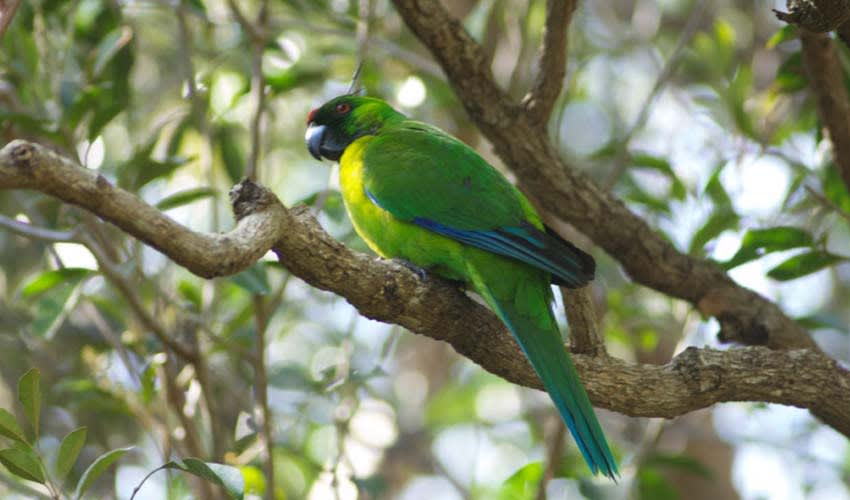
Found only on the small island of Ouvéa in New Caledonia, this parakeet immediately stands out with its bright green body and the narrow, horn-like feathers that rise from the top of its head. These unique feathers give the bird a bold and slightly quirky look that sets it apart from most other parakeets. Touches of black, yellow, and red on the face add contrast, while its long tail and strong wings make it an agile flier through forest canopies.
Life on a small island has shaped the Ouvea parakeet in remarkable ways. It depends heavily on native forests, especially older trees that provide natural cavities for nesting. Unlike parrots that adapt easily to human-altered landscapes, this species prefers quiet, undisturbed areas. It spends much of its day moving through the trees in pairs or small groups, searching for fruits, seeds, buds, and flowers. Its strong curved beak allows it to handle tough food, while its feet are used skillfully to grasp and manipulate meals. The bird’s movements are confident and energetic, yet it can sit perfectly still when resting, blending almost completely into the greenery.
Social behavior plays a major role in the Ouvea parakeet’s life. These birds are highly vocal, using sharp calls to stay in contact as they move through dense foliage. Mated pairs form strong bonds and are often seen close together, preening and feeding side by side. During the breeding season, both parents participate in caring for the young, demonstrating a high level of cooperation. Their loyalty to partners and nesting sites adds to their charm and highlights how closely their survival is tied to stable, healthy forests.
Distribution
 New Caledonia
 Official estimate
Anything we've missed?
Help us improve this page by suggesting edits. Glory never dies!
Suggest an editGet to know me
Terrestrial / Aquatic
Altricial / Precocial
Polygamous / Monogamous
Dimorphic (size) / Monomorphic
Active: Diurnal / Nocturnal
Social behavior: Solitary / Pack / Flock
Diet: Carnivore / Frugivore / Omnivore / Piscivorous / Insectivore
Migratory: Yes / No
Domesticated: Yes / No
Dangerous: Yes / No




