


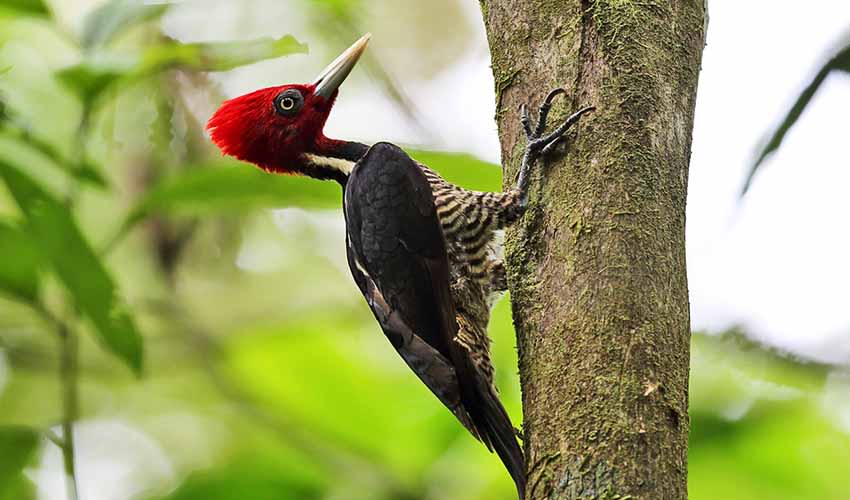
Found primarily from Mexico down through Central America, this bird is a titan of the treetops. It shares that iconic, fiery-red crest that seems to defy gravity, but it carries itself with a slightly more “industrial” aesthetic. What truly sets it apart at first glance is—as the name suggests—its massive, ivory-colored beak. This isn’t just a tool; it’s a powerful chisel made of toughened keratin that looks almost like it was carved from bone, standing out sharply against its deep black-and-red plumage.
Distinguishing the pale-billed from the crimson-crested woodpecker is a classic birdwatcher’s challenge, but the secret is in the “suit” design. While the crimson-crested has two white lines that meet in a “V” on its back, the pale-billed woodpecker keeps things a bit more minimalist. It features two parallel white stripes that run down its back, never actually touching. Think of it like racing stripes on a car; if they merge, it’s a crimson-crested; if they stay separate, you’ve found a pale-billed. Furthermore, while the female crimson-crested has a white stripe on her face, the female pale-billed has a black forehead, making her red crest appear to sit further back on her head.
The pale-billed woodpecker is famous for its “voice,” which isn’t a song at all, but a rhythmic declaration of power. Like other members of the Campephilus genus, it performs a signature double-tap drum. However, the pale-billed version is legendary for its resonance. It hits the wood with such force and speed—BAM-BAM!—that it can sound like a distant gunshot or a carpenter slamming a hammer. This isn’t just for finding food; it’s a high-decibel social media post. By drumming on the most hollow, resonant branch it can find, it broadcasts its health and territory to every other bird in the valley.
Distribution
 Belize
 Costa Rica
 El Salvador
 Guatemala
 Honduras
 Mexico
 Nicaragua
 Panama
Anything we've missed?
Help us improve this page by suggesting edits. Glory never dies!
Suggest an editGet to know me
Terrestrial / Aquatic
Altricial / Precocial
Polygamous / Monogamous
Dimorphic (size) / Monomorphic
Active: Diurnal / Nocturnal
Social behavior: Solitary / Pack / Herd
Diet: Carnivore / Herbivore / Omnivore / Piscivorous / Insectivore
Migratory: Yes / No
Domesticated: Yes / No
Dangerous: Yes / No




