


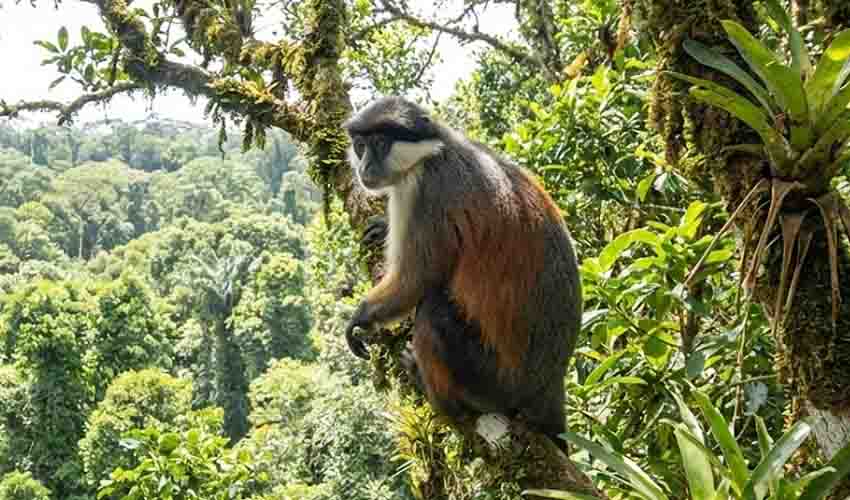
Best known for its dramatic black-and-white appearance and its quiet, tree-bound lifestyle. It belongs to the group of colobus monkeys, which are leaf-eating primates adapted to life high in the forest canopy. Pennant’s colobus has glossy black fur contrasted by long, flowing white hair along its sides and shoulders, giving it an elegant, almost cloak-like look. Its face is framed by white fur, highlighting dark eyes that appear calm and observant.
This monkey lives primarily in dense tropical forests, where tall trees provide food, shelter, and safe travel routes above the ground. Pennant’s colobus spends most of its time in the canopy, rarely descending to the forest floor. It moves through the trees by combining climbing and powerful leaps, relying on balance and precision rather than speed. Its long tail helps with stability as it navigates narrow branches. Because it lives high above the ground, it often remains hidden from view, and its presence is sometimes only revealed by movement in the leaves or distant calls.
Pennant’s colobus is a specialized plant eater, feeding mainly on young leaves, shoots, fruits, and seeds. Its digestive system is specifically adapted to handle tough, fibrous plant material, allowing it to extract nutrients that many other animals cannot. This diet shapes much of its daily routine, as groups move carefully between feeding trees. By feeding on leaves and fruits, the monkey also helps shape forest growth and spread seeds, contributing to the health and balance of its ecosystem.
What sets Pennant’s colobus apart from many other monkeys is its calm and reserved nature. It is less aggressive and less noisy than some primate species, relying on height, camouflage, and group awareness for safety. Its striking coat, while beautiful, also helps break up its outline among sunlit leaves and shadows.
Distribution
 Equatorial Guinea
 Official estimate
Anything we've missed?
Help us improve this page by suggesting edits. Glory never dies!
Suggest an editGet to know me
Terrestrial / Aquatic
Altricial / Precocial
Polygamous / Monogamous
Dimorphic (size) / Monomorphic
Active: Diurnal / Nocturnal
Social behavior: Solitary / Pack / Troop
Diet: Carnivore / Herbivore / Omnivore / Piscivorous / Insectivore
Migratory: Yes / No
Domesticated: Yes / No
Dangerous: Yes / No




