


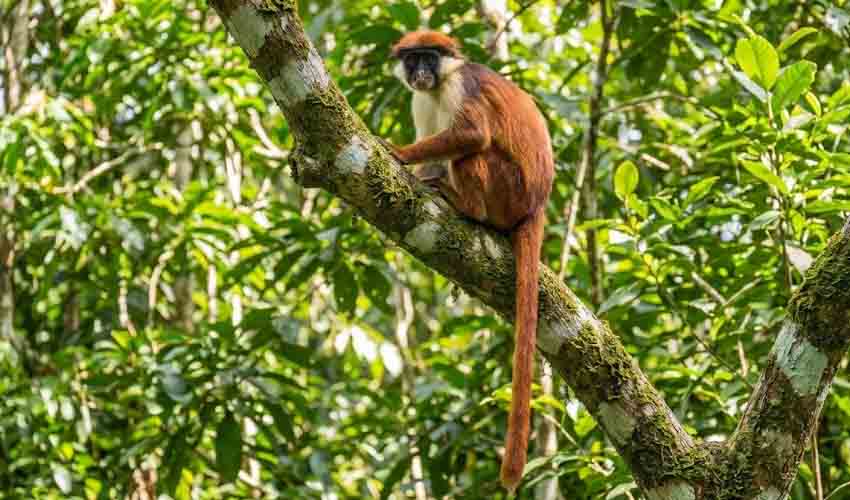
A rare and striking monkey found only in a small region of Central Africa, mainly in parts of Cameroon and Nigeria. It belongs to the red colobus group, a collection of monkeys known for their rich reddish coats and tree-dwelling lifestyles. Preuss’s red colobus has a warm chestnut to deep red-brown body, contrasted by darker limbs and a lighter underside. Its face is dark and expressive, framed by short fur, giving it a thoughtful, almost gentle appearance.
This species lives almost entirely in tall tropical forests, where it depends on continuous tree cover for food, movement, and safety. Preuss’s red colobus rarely comes down to the ground, instead traveling high above it by climbing and leaping between branches. Its long tail helps with balance during these movements, though it is not used for grasping. The monkey prefers mature forests with a wide variety of tree species, which provide a steady supply of leaves and other plant foods.
Preuss’s red colobus is mainly a leaf eater, feeding on young leaves, shoots, fruits, seeds, and flowers. Its digestive system is specially adapted to break down tough plant material, allowing it to survive on foods that many other animals cannot digest efficiently. This diet shapes its daily routine, as groups move slowly through the canopy, feeding and resting for long periods. By consuming leaves and fruits, the monkey also plays an important role in shaping forest vegetation and spreading seeds, contributing to the overall health of the ecosystem.
Socially, Preuss’s red colobus lives in groups that usually include several females, their offspring, and one or more males. Group members stay close together while feeding and resting, maintaining strong social bonds. Communication within the group relies on soft calls, body posture, and visual signals rather than constant loud noise. Grooming is an important activity, helping strengthen relationships and reduce tension
Distribution
 Cameroon
 Nigeria
Anything we've missed?
Help us improve this page by suggesting edits. Glory never dies!
Suggest an editGet to know me
Terrestrial / Aquatic
Altricial / Precocial
Polygamous / Monogamous
Dimorphic (size) / Monomorphic
Active: Diurnal / Nocturnal
Social behavior: Solitary / Pack / Troop
Diet: Carnivore / Herbivore / Omnivore / Piscivorous / Insectivore
Migratory: Yes / No
Domesticated: Yes / No
Dangerous: Yes / No




