


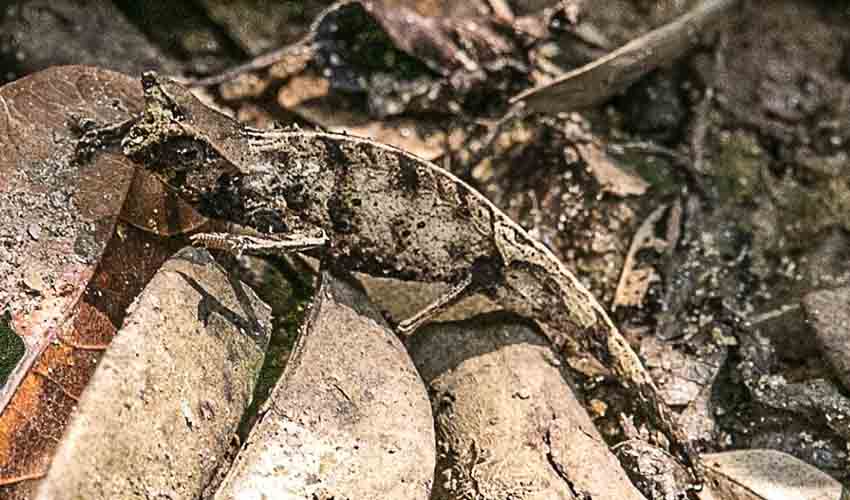
Named after the Perinet region (Andasibe) in eastern Madagascar, this species lives quietly among fallen leaves, moss, and twigs, perfectly adapted to a world just a few centimeters above the forest floor.
This little chameleon is small and compact. Its coloration varies from brown and reddish tones to muted greens and grays, all of which help it blend seamlessly with its forest surroundings. Its body is covered in tiny ridges, bumps, and leaflike patterns, mimicking the texture of decaying foliage. When still, it looks almost identical to a curled, dried leaf on the forest floor—a disguise so effective that even experts often miss it unless it moves. Its large, independently rotating eyes allow it to survey the world in every direction without shifting its body, an essential trait for spotting prey while staying invisible to predators.
The Perinet leaf chameleon is an ambush hunter, feeding on tiny insects, spiders, and other invertebrates that wander through the forest litter. It relies entirely on patience and precision: when prey comes within reach, it extends its extraordinarily long tongue—sometimes longer than its own body—to catch it in a split second. Unlike the more colorful, tree-dwelling chameleons, Brookesia species like this one can’t drastically change their colors, but they can make subtle adjustments in tone and brightness to better match their surroundings. During the day, they creep slowly across the forest floor, and at night, they climb onto low twigs or stems to sleep safely above ground, where their pale nighttime coloration helps them blend with the dim light of the forest.
Though it’s one of the lesser-known chameleon species, the Perinet leaf chameleon plays an important role in Madagascar’s rainforest ecosystem. It helps control insect populations, keeping the delicate balance of the forest floor intact. Despite its tiny size, it’s a hardy survivor, adapted to the cool, humid conditions of Madagascar’s eastern rainforests.
Distribution
 Madagascar
Anything we've missed?
Help us improve this page by suggesting edits. Glory never dies!
Suggest an editGet to know me
Terrestrial / Aquatic
Altricial / Precocial
Polygamous / Monogamous
Dimorphic (size) / Monomorphic
Active: Diurnal / Nocturnal
Social behavior: Solitary / Pack / Herd
Diet: Carnivore / Herbivore / Omnivore / Piscivorous / Insectivore
Migratory: Yes / No
Domesticated: Yes / No
Dangerous: Yes / No




