


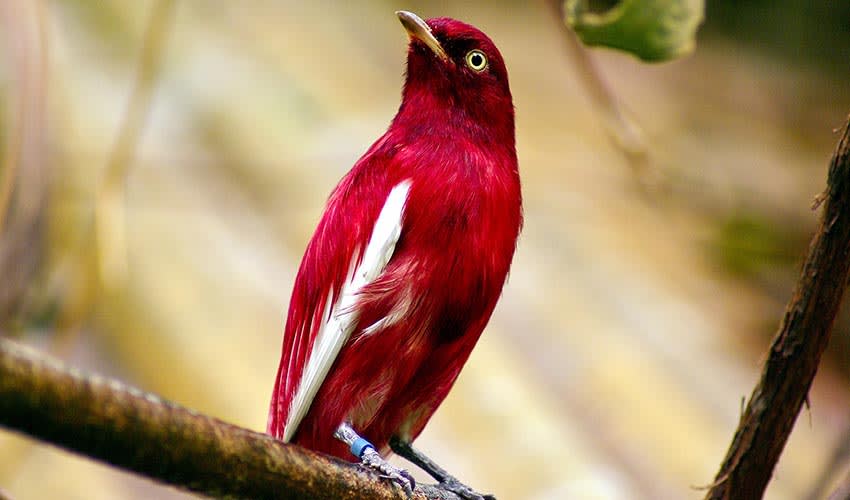
Found in the tropical forests of South America, especially in the Amazon region, this bird stands out for its smooth shape and bold coloring. Males are famous for their deep purple bodies, which can appear dark and velvety in shade and suddenly glow with richness when sunlight hits just right. Females look very different, wearing softer brown tones that help them blend into the forest. This big difference between males and females makes the pompadour cotinga especially interesting, as it shows how color is used both for attraction and for staying hidden.
Unlike loud or flashy species, it doesn’t rely on constant calls or dramatic movement. Instead, it spends much of its time sitting still high in the canopy, moving only when necessary. Its calls are soft and low, easy to miss unless you’re paying close attention. This calm lifestyle helps it avoid danger and suits its forest home, where patience is often more useful than speed. While many colorful birds dart around, the pompadour cotinga prefers a slow, steady approach, making it feel more like a peaceful presence than an attention-seeker.
Fruit plays a huge role in the pompadour cotinga’s life. It is mainly a fruit eater, carefully choosing ripe berries and forest fruits and swallowing them whole. This diet makes it an important helper for the rainforest, because it spreads seeds as it travels from tree to tree. In a way, the pompadour cotinga helps shape the forest without even trying, allowing new plants to grow far from the parent trees. It also has a good memory for food sources, returning to fruiting trees at the right time of year. This focus on fruit explains why the bird is so closely tied to healthy, mature forests and why it is rarely seen outside dense woodland.
Distribution
 Bolivia
 Brazil
 Colombia
 Ecuador
 French Guiana
 Guyana
 Peru
Peru Suriname
 Venezuela
Anything we've missed?
Help us improve this page by suggesting edits. Glory never dies!
Suggest an editGet to know me
Terrestrial / Aquatic
Altricial / Precocial
Polygamous / Monogamous
Dimorphic (size) / Monomorphic
Active: Diurnal / Nocturnal
Social behavior: Solitary / Pack / Herd
Diet: Carnivore / Frugivore / Omnivore / Piscivorous / Insectivore
Migratory: Yes / No
Domesticated: Yes / No
Dangerous: Yes / No




