


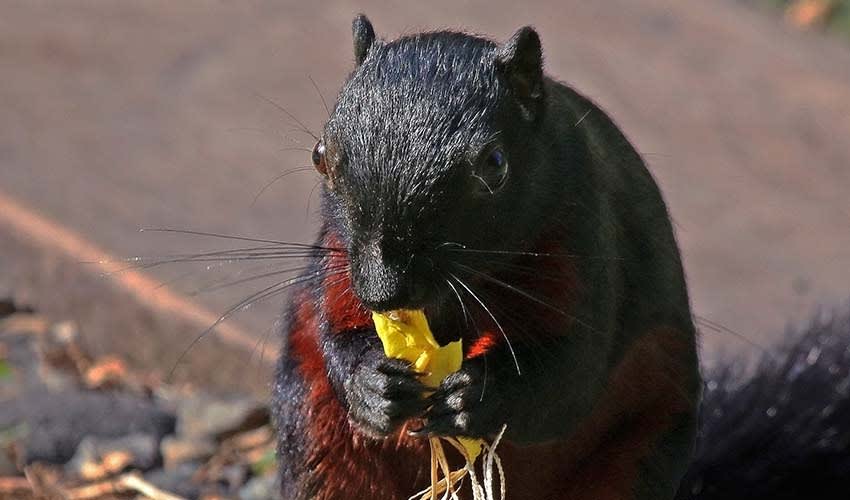
Found throughout Southeast Asia—particularly in Borneo, Sumatra, Peninsular Malaysia, and surrounding islands—this vibrant tree squirrel is instantly recognizable due to its bold, tri-colored body. In the dense rainforests where it lives, its bright coloration stands out dramatically among the greenery, making it one of the region’s most charismatic small mammals.
The most captivating feature of the Prevost’s squirrel is its extraordinary coloration, which looks almost painted. The classic color form features a black back, bright reddish-orange sides, a white or cream belly, and a glossy tail that may be black, gray, or frosted at the tip. This bold palette makes the species look like it is wearing a custom-designed costume. However, depending on the region, color variations can occur—some individuals have darker bellies, deeper chestnut flanks, or different tail shades. This striking appearance makes the Prevost’s squirrel easy to identify even at a distance.
In terms of size, the Prevost’s squirrel is medium to large for a tree squirrel. Its limbs are strong and flexible, well-suited for climbing, leaping, and balancing among branches. The species is diurnal and highly arboreal, spending most of its time in the mid to upper canopy. Its long, fluffy tail acts as a counterbalance, allowing it to make daring leaps between tree limbs with remarkable precision.
Prevost’s squirrels are primarily frugivores, meaning fruit makes up a large part of their diet. They also eat seeds, nuts, flowers, buds, shoots, and occasionally insects. By consuming fruit and dropping or burying seeds elsewhere, they play a valuable role in seed dispersal, helping maintain the health and diversity of tropical forests. Their foraging is active and energetic; watching one move through the canopy can feel like observing a burst of color streaking through the trees.
Distribution
 Brunei
 Indonesia
 Malaysia
 Thailand
Anything we've missed?
Help us improve this page by suggesting edits. Glory never dies!
Suggest an editGet to know me
Terrestrial / Aquatic
Altricial / Precocial
Polygamous / Monogamous
Dimorphic (size) / Monomorphic
Active: Diurnal / Nocturnal
Social behavior: Solitary / Pack / Herd
Diet: Carnivore / Frugivore / Omnivore / Piscivorous / Insectivore
Migratory: Yes / No
Domesticated: Yes / No
Dangerous: Yes / No


