


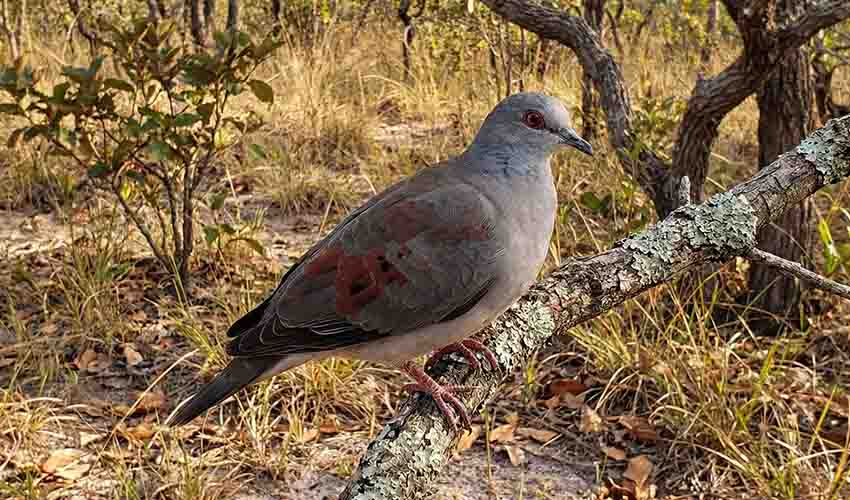
One of the most elusive birds in South America—a dove that has become famous largely because so few people have seen it. It comes from the Atlantic Forest region, with historical records centered on south-eastern Brazil, plus pockets in far eastern Paraguay and north-eastern Argentina (Misiones). At a glance, it’s a gentle-looking, medium-small dove with soft grey-brown tones, but the “purple-winged” name hints at its most memorable feature: males show a rich violet or purple sheen on the wings that can flash in the right light and then disappear again as the bird slips back into shadow. Like many forest doves, it’s built for quick, low flights and quiet movement, not for showy long glides in the open.
What makes this species truly different is how closely its life seems tied to bamboo. Researchers describe it as a bamboo specialist that likely moves around to track bamboo “boom” years—those times when bamboo produces huge amounts of seed. Imagine living in a neighborhood where your favorite food only appears in massive bursts every so often, and you have to roam to find it; that’s the basic idea. This lifestyle can make the bird hard to detect even if it’s still out there: it may be absent from a place for years, then briefly appear when bamboo is seeding. It also means habitat loss hits it especially hard. When the Atlantic Forest was cut into smaller and smaller fragments, the chain of bamboo-rich places the dove might have relied on likely broke apart, leaving fewer safe “food events” to hop between.
Another reason it’s so difficult to confirm is that it can be confused with similar doves, especially in quick glimpses in dim forest light. Reports note mix-ups with other ground-dove species in the same region, which adds uncertainty to many modern sight records. That confusion matters because the Purple-winged ground dove is listed as Critically Endangered, and there have been no widely accepted, verifiable records for decades, leading to ongoing debate about whether it still survives or has already vanished.
Distribution
 Argentina
 Brazil
 Paraguay
Anything we've missed?
Help us improve this page by suggesting edits. Glory never dies!
Suggest an editGet to know me
Terrestrial / Aquatic
Altricial / Precocial
Polygamous / Monogamous
Dimorphic (size) / Monomorphic
Active: Diurnal / Nocturnal
Social behavior: Solitary / Pack / Flock
Diet: Carnivore / Granivore / Omnivore / Piscivorous / Insectivore
Migratory: Yes / No
Domesticated: Yes / No
Dangerous: Yes / No




