


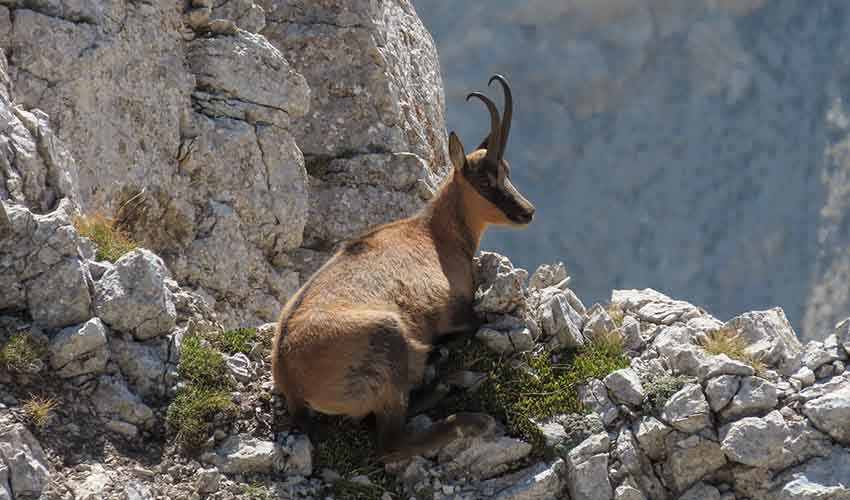
A nimble mountain goat-antelope that seems perfectly built for the steep ridges and high meadows of the Pyrenees. It has a compact, athletic body, long, slim legs, and hooves designed for gripping rock, scree, and wet grass without slipping. Its coat changes with the seasons: in warmer months it is usually lighter brown and sleeker, while in winter it becomes thicker, darker, and more insulating—like it’s putting on a mountain parka. The face is especially distinctive, with a pale muzzle and bold dark stripes that run from the eyes toward the nose, giving it a masked, alert expression.
Compared with some close relatives in other regions, the Pyrenean chamois is shaped by a landscape that can shift quickly from wooded slopes to open heights, so it is comfortable moving between cover and open grassland depending on season and safety. Its coat tends to show strong seasonal contrast, and the facial markings are a key “signature” that helps distinguish it from many other mountain hoofed animals at a glance. The horns—shorter than those of many goats but sharply curved—are another classic clue, and because both sexes carry them, even young animals can look surprisingly “armored” for their size.
Daily life for a Pyrenean chamois is a careful balance between eating enough and staying safe. It feeds mostly on grasses, herbs, and young shoots, with leaves and buds added when the menu changes with season or altitude. In summer, it can spend long hours grazing in alpine meadows, where food is rich but cover is scarce, so it often chooses places with quick access to cliffs or steep slopes. In winter, it may shift to lower elevations or sunnier faces where snow is thinner, and plants are easier to reach.
Distribution
 Andorra
 France
 Italy
Italy Spain
SpainAnything we've missed?
Help us improve this page by suggesting edits. Glory never dies!
Suggest an editGet to know me
Terrestrial / Aquatic
Altricial / Precocial
Polygamous / Monogamous
Dimorphic (size) / Monomorphic
Active: Diurnal / Nocturnal
Social behavior: Solitary / Pack / Herd
Diet: Carnivore / Herbivore / Omnivore / Piscivorous / Insectivore
Migratory: Yes / No
Domesticated: Yes / No
Dangerous: Yes / No




