


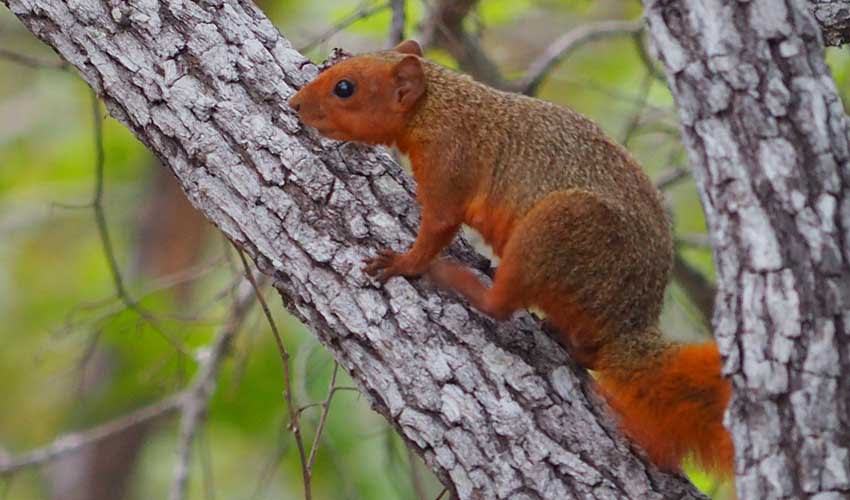
A lively, colorful, and wide-ranging African tree squirrel found across the woodlands, forests, and coastal thickets of eastern and southeastern Africa. Its range includes Kenya, Tanzania, Mozambique, Zimbabwe, Malawi, and northeastern South Africa, where it thrives in environments rich in trees and thick vegetation.
One of the defining features of the Red bush squirrel is its distinctive reddish or rufous fur, which varies slightly across its wide distribution. Some individuals show deep rusty-orange coloration, while others are lighter or more brownish with red highlights. The belly is often paler, sometimes creamy or whitish, and the tail is thick, bushy, and expressive, helping the squirrel balance as it moves through branches. Its bright coloration helps it blend surprisingly well with sunlit foliage and reddish-brown bark.
The species is primarily arboreal, spending much of its day moving through trees in search of food. Its claws are sharp and curved—perfect for gripping bark and hopping confidently between branches. Nonetheless, Red bush squirrels are also comfortable on the ground, especially when pursuing fallen fruits or seeds. Their quick, darting movements and alert posture make them difficult for predators to catch, and their agility allows them to escape upwards into trees at the slightest threat.
The Red bush squirrel’s diet is broad and adaptable. It feeds on nuts, seeds, fruits, flowers, buds, young leaves, insects, and sometimes small invertebrates. This varied diet allows it to thrive in different habitats, including disturbed or secondary forests. Like many squirrels, it occasionally stores excess food, caching it in hidden places to retrieve later. In doing so, it becomes an important seed disperser, subtly shaping forest structure and aiding plant regeneration.
Distribution
 Kenya
Kenya Malawi
 Mozambique
 Somalia
 South Africa
 Tanzania
 Zimbabwe
Anything we've missed?
Help us improve this page by suggesting edits. Glory never dies!
Suggest an editGet to know me
Terrestrial / Aquatic
Altricial / Precocial
Polygamous / Monogamous
Dimorphic (size) / Monomorphic
Active: Diurnal / Nocturnal
Social behavior: Solitary / Pack / Herd
Diet: Carnivore / Herbivore / Omnivore / Piscivorous / Insectivore
Migratory: Yes / No
Domesticated: Yes / No
Dangerous: Yes / No




